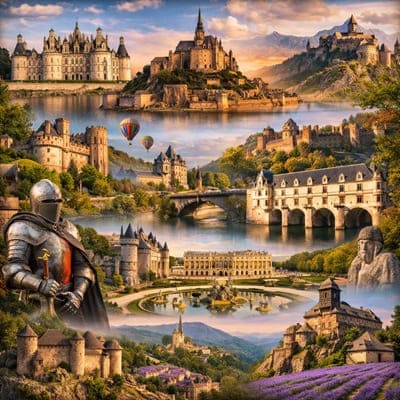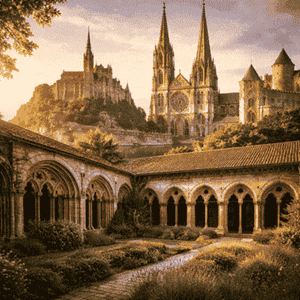
01. CHATEAU DE CHAMBORD
Built in the heart of the largest enclosed forest park in Europe (approximately 50 km² surrounded by a 32 km long wall), it is the largest of the Loire Valley châteaux. It boasts a formal garden and a hunting park, both listed as historical monuments. Chambord is the only royal estate that remains intact since its creation.
02. CHATEAU CHENONCEAU
Chenonceau, with its famous two-story gallery overlooking the Cher River, is one of the jewels of Loire Valley architecture. Its Italian influences and French characteristics are clearly visible. Of the original building, only the Tour des Marques remains today, a vestige of the medieval castle that borders the Cher. Chenonceau was built, furnished, and transformed by women of very different temperaments. It was built by Katherine Briaçonnet in 1513, enriched by Diane de Poitiers, and enlarged under Catherine de Medici. It became a place of retreat under the White Queen Louise of Lorraine, then it was saved by Louise Dupin during the French Revolution, and finally, transformed by Madame Pelouze. Due to the large number of women who have been in charge of it, it is nicknamed "the Ladies' Castle." The private estate of Chenonceau has belonged to the Menier family since 1913 and is open to the public. The castle has been listed as a historical monument since its initial inscription on the list in 1840, and the park by decree dated November 7, 1962. The building and its surroundings have been part of the Loire Valley, a UNESCO World Heritage Site, since July 9, 2017.
03. CHATEAU ROYAL D'AMBOISE
The Renaissance Balcony Perched on a rocky spur, the Château d’Amboise offers one of the most beautiful panoramas in the Loire Valley. A former residence of the kings of France, this monument marks a major turning point in history: it was here that Italian influence took firm root at court, transforming the medieval fortress into a Renaissance palace of exceptional refinement. A visit is a journey to the heart of royal power, from the richly furnished apartments to the imposing cavalier towers (the Tour des Minimes and the Tour Heurtault), whose gently sloping ramps once allowed horses and carriages direct access to the terraces. But the site is also inextricably linked to a universal figure: Leonardo da Vinci. Invited by Francis I, the Tuscan genius spent the last years of his life in Amboise and now rests in the Saint-Hubert Chapel, a jewel of Flamboyant Gothic sculpture suspended above the void. Between its Mediterranean gardens, its ramparts steeped in history and its sweeping views of the royal river, the Château d'Amboise perfectly embodies French elegance and art de vivre.
04. CHATEAU DE CHATEAUDUN
A microcosm of French history
Proudly overlooking the Loir Valley from atop a rocky spur, the Château de Châteaudun presents a unique silhouette where several centuries of architecture are superimposed. The monument is famous for its impressive 12th-century circular keep, one of the best preserved in the world, which stands alongside a Sainte-Chapelle built by Jean de Dunois, the infamous "Bastard of Orléans" and companion-in-arms of Joan of Arc. This rare juxtaposition allows visitors to observe, on a single site, the stark and fascinating transition between the austere military fortress and the comfortable lordly residence of the late Middle Ages.
The interior of the château houses unexpected treasures, including a collection of Gobelins and Beauvais tapestries, as well as a monumental staircase with finely sculpted Renaissance decoration. The two wings of the château (the Dunois wing and the Longueville wing) perfectly illustrate the transition from Flamboyant Gothic to Renaissance style. Wandering through its vaulted rooms and medieval kitchens, the visitor travels back in time, carried by the spirit of chivalry and the elegance of the first great French pleasure houses.
05. CHATEAU AZAY LE RIDEAU
06. CHATEAU DE BLOIS
Here is a tourist description of the Royal Château of Blois, designed for a guidebook, highlighting its unique architectural diversity and its connection to action cinema. The Royal Château of Blois: A Condensed History of France Proudly overlooking the Loire River, the Château of Blois is the ideal key to understanding the evolution of French architecture. Its inner courtyard is an open-air spectacle, bringing together four different styles in a single space: medieval Gothic, Italian Renaissance, Classicism, and the Louis XII style. Its most iconic feature remains the famous spiral staircase of Francis I, a true feat of openwork sculpture that soars towards the sky. The château was the scene of major historical events, such as the assassination of the Duke of Guise, but it also possesses a lighter, more spectacular side. This majestic setting has naturally attracted the film industry. The shadow of Jean-Paul Belmondo lingers here in swashbuckling scenes and period films, where his natural panache resonates with the grandeur of the setting. Between the richly colored royal apartments and the sound and light show that illuminates its facades at nightfall, Blois offers a captivating royal immersion, both scholarly and dynamic.
07. DOMAINE DE CHAUMONT SUR LOIRE
One of the jewels of the Loire Valley, the Domaine de Chaumont-sur-Loire is distinguished by its unique identity, blending fairytale-like feudal architecture with a resolutely contemporary artistic program. Historically, the château is famous for having belonged to Catherine de Medici, who exchanged it for Chenonceau with her rival, Diane de Poitiers. Its architecture, marked by heavy circular towers and a drawbridge, retains the appearance of a medieval fortress, while having been extensively embellished during the Renaissance and then in the 19th century by the wealthy owners of the Broglie family. They also had luxurious stables built there, considered at the time to be the most modern in Europe, reflecting the splendor of aristocratic life before the First World War. From a tourism perspective, the estate is now a world-renowned destination thanks to its International Garden Festival, which takes place every year from April to November. This landscape laboratory allows designers from around the world to create ephemeral installations around an environmental or poetic theme, offering a constantly evolving experience within the historic park. In addition to its 32 hectares of greenery, the château houses spectacular contemporary art installations, integrated even into the attics and gardens. This bold blend of classical architectural heritage and avant-garde plant art makes Chaumont a unique destination, attracting history buffs as well as design and nature enthusiasts.
08. FORTERESSE ROYALE DE CHINON
Located in the heart of the Loire Valley, the Royal Fortress of Chinon is an extraordinary monument that majestically overlooks the Vienne River. Unlike the later Loire châteaux, Chinon is a true medieval citadel composed of three distinct castles separated by moats. It is a place steeped in history: it was the preferred residence of the Plantagenet kings, notably Henry II and Eleanor of Aquitaine, and the site of the decisive meeting between Joan of Arc and the future Charles VII in 1429. The appeal of the visit lies in the perfect balance between raw history and modern technology. The royal apartments have been magnificently restored, offering sumptuous reception rooms, while the defensive towers and ramparts allow for an immersive experience of medieval military architecture. The route is interactive and fun, making the exploration of this stone giant exciting, whether you are a military strategy enthusiast or a fan of epic tales of chivalry.