01. ABBAYE DU MONT SAINT MICHEL
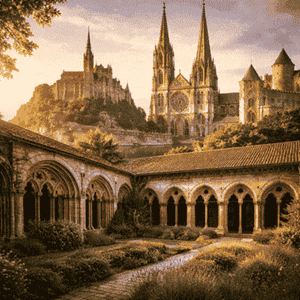
Rising from the sands of the bay, Mont-Saint-Michel Abbey is an architectural marvel that has defied the elements for over a millennium. This sanctuary, dedicated to the Archangel Saint Michael, is a masterful blend of styles, ranging from Romanesque to Flamboyant Gothic. The visit culminates in the cloister, suspended between sky and sea, and in the Hall of the Marvel, a jewel of monastic architecture. Beyond its religious significance, this granite labyrinth has always captivated filmmakers. Its imposing fortress-like appearance has served as the backdrop for numerous cinematic productions. Notably, it evokes the spirit of Jean-Paul Belmondo in The Inheritor, where the monumental aesthetic of the Mont underscores the power of the narrative. Between the vertiginous staircases and the terraces offering panoramic views of the highest tides in Europe, the abbey provides an extraordinary sensory and historical experience. Listed as a UNESCO World Heritage Site, it remains the eternal symbol of the alliance between human ingenuity and wild nature.
02. ABBAYE DU THORONET
Thoronet Abbey, nestled in the Var hinterland, is the absolute embodiment of Cistercian rigor. Built between 1160 and 1230, it forms, along with Silvacane and Sénanque, the trio of the "Three Sisters of Provence." Here, there are no superfluous ornaments: beauty arises from the purity of lines, the perfect geometry of the hewn stone, and world-renowned natural acoustics. It is a place where architectural simplicity achieves a universal spiritual dimension.
Walking through its shaded cloister or its church with its understated vaults, one is struck by the constant interplay between stone and Provençal light. The site also profoundly inspired the architect Le Corbusier in the design of the La Tourette monastery. Visiting Le Thoronet is like taking a meditative break, far from the hustle and bustle of the French Riviera, in the heart of a holm oak forest where time seems to have stopped in the 12th century.
03. ABBAYE DE FONTENAY
A UNESCO World Heritage Site, Fontenay Abbey is undoubtedly the best-preserved example of Cistercian architecture in the world. Founded in 1118 by Saint Bernard of Clairvaux in a secluded valley in Burgundy, it has survived the centuries with remarkable integrity. Here, there are no ruins: all the buildings (church, cloister, dormitory, forge) are intact, offering a direct journey into the daily life of 12th-century monks.
Fontenay's aesthetic is based on simplicity: the absence of superfluous decoration allows one to appreciate the perfection of the proportions and the mastery of the stonework. The cloister, the true heart of the abbey, is a masterpiece of serenity with its vaulted galleries opening onto an impeccably maintained central garden. The visit also includes the monumental forge, one of the oldest metallurgical factories in Europe, illustrating the technical genius of the Cistercians who knew how to harness the hydraulic energy of the nearby stream.
04. ABBAYE DE CLUNY
A true "beacon of the West" in the Middle Ages, Cluny Abbey was the intellectual heart of a monastic empire stretching across Europe. Founded in 910, it housed the largest church in Christendom (the Maior Ecclesia) until the construction of St. Peter's Basilica in Rome. Although dismantled after the French Revolution, the remaining vestiges—notably the great south transept arm and its holy water tower—are enough to inspire awe and bear witness to the immense power of the abbots of Cluny, who answered only to the Pope.
A visit is a fascinating archaeological investigation in the heart of Burgundy. Visitors will discover exquisitely sculpted capitals, masterpieces of Romanesque art, as well as the vast complex of 18th-century convent buildings surrounding the medieval ruins. The site is striking in its duality: on one side, the intact splendor of the abbot's palace and the classical cloister; on the other, the colossal fragments of the vanished church which force the imagination to reconstruct what was, for centuries, the spiritual center of the known world.
05. ABBAYE NOTRE-DAME DE FONTEVRAUD
The Royal Abbey of Notre-Dame de Fontevraud is a former Benedictine-inspired abbey, the seat of the Order of Fontevraud, founded in 1101 by Robert of Arbrissel and located in Fontevraud, near Saumur in Anjou (present-day Maine-et-Loire). A 13-hectare site situated on the border between Anjou, Poitou, and Touraine, it is one of the largest monastic complexes in Europe.
06. ABBAYE DE BEC HELLOUIN
Nestled in a verdant valley in Normandy, Notre-Dame du Bec-Hellouin Abbey has been a center of Benedictine spirituality since the 11th century. Although its origins are medieval, the imposing Saint-Nicolas Tower and the 18th-century convent buildings lend it the air of a classical palace of rare elegance. This monastery, which exerted its influence throughout Europe during the Middle Ages, remains today a vibrant center of monastic life where the silence is broken only by birdsong.
The charm of the site lies as much in the majesty of its architecture as in its natural setting. Strolling through the cloister or admiring the façade of the Saint-Nicolas Tower, one discovers a preserved heritage that has survived the vicissitudes of history. The adjoining village, classified among the "Most Beautiful Villages of France" with its colorful half-timbered houses, extends the magic of the visit and offers an enchanting interlude away from time and urban bustle.
07. ABBAYE DE JUMIEGE
Rightly dubbed "the most beautiful ruin in France" by Victor Hugo, Jumièges Abbey raises its majestic towers in the heart of a bend in the Seine River in Normandy. This masterpiece of Romanesque art, founded in the 7th century and rebuilt in the 11th, impresses with its monumental dimensions and its white towers that soar to a height of nearly 50 meters. The absence of a roof, far from spoiling the spectacle, allows the light to flood in, creating an open-air architecture where the stone seems to converse with the elements.
A visit is a poetic stroll through a 15-hectare wooded park. Walking between the open arcades of the nave and the remains of the Church of Saint Peter, one senses the past power of this major intellectual and spiritual center of the Middle Ages. The contrast between the chalky white of the limestone and the deep green of the surrounding lawns provides a melancholic and grandiose setting, ideal for photography and history enthusiasts.
08. ABBAYE SAINT PIERRE DE MOISSAC
A major stop on the Way of St. James, the Abbey of Saint-Pierre in Moissac is world-renowned for its cloister and portal, true masterpieces of Romanesque art. A UNESCO World Heritage Site, it has been a beacon of influence in the Tarn-et-Garonne region since its legendary founding by King Clovis. While the abbey church impresses with its blend of Romanesque and Gothic styles, it is the sculpted tympanum that truly captivates visitors: a monumental vision of the Apocalypse, executed with unparalleled finesse and expressive power.
However, the true treasure of Moissac remains its cloister, completed in 1100. It is one of the largest and best-preserved in the world, boasting 76 unique sculpted capitals. Each column tells a story: biblical scenes, fantastical figures, and plant motifs intertwine with exquisite precision. Wandering under its galleries, in the shade of the two-hundred-year-old cedar that stands in its center, offers a moment of absolute calm and a fascinating plunge into the medieval imagination.