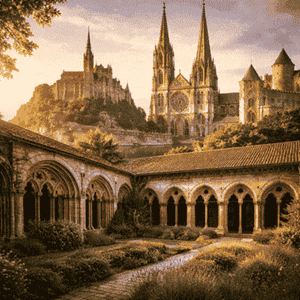
01. CATHEDRALE NOTRE-DAME DE REIMS
La Cathédrale Notre-Dame de Reims, absolute chef-d'œuvre of gothic art, is well beyond a simple religious building: it is the theater of the history of France. Inscribed in the UNESCO world heritage site, the lieu du sacre de 33 rois de France, de Clovis (according to tradition) to Charles Sa structure élancée et la finesse de son architecture en font l'un des témoignages les plus purs du style gothic classique du XIIIe siècle.
Inside, the motion is poured out with a nef of a vertiginous hauteur baignée by a mystical luminaire. La cathédrale est mondialement connue pour ses vitraux exceptionnels qui marient les époques avec brio: des grandes roses médiévales aux créations contemporaines de Marc Chagall (1974) et d'Imi Knoebel. Entre les murs qui ont vu passer Jeanne d'Arc et les rois de France, chaque pierre semble murmurer les secrets de la monarchie et de la réconciliation franco-allemande, faisant de cet édifice un passage obligé lors d'une escape in Champagne.
02. CATHEDRALE DE CHARTRES
The Bible of Stone and Glass Erected with exceptional speed at the beginning of the 13th century, Chartres Cathedral is one of the most authentic monuments of the medieval period. It is world-renowned for its original stained-glass windows, which constitute the largest collection of ancient stained glass in the world. Upon passing through its Royal Portal, you will discover a unique light, filtered by the legendary "Chartres Blue," whose brilliance remains unmatched. This stone vessel, both massive and ethereal, also houses the famous Labyrinth, a spiritual path laid out on the floor that has invited pilgrims to meditation for centuries. Beyond its stained glass, Chartres impresses with the richness of its statuary and the verticality of its vaults. Its two mismatched spires, which dominate the Beauce plain, bear witness to the evolution of architectural styles, from early Gothic to Flamboyant Gothic. The sanctuary also houses the Veil of the Virgin, a precious relic that made the city a major pilgrimage center from the Middle Ages onward. Every corner of the building seems to tell a story, making this cathedral a veritable encyclopedia of faith and the craftsmanship of cathedral builders.
03. CATHEDRALE SAINT LAZARE D'AUTUN
Dominating the Burgundian city, Autun Cathedral, dedicated to Saint Lazarus, is one of the pinnacles of Cluniac Romanesque art. Erected in the 12th century to house the relics of Lazarus, it is world-renowned for the power of its architecture and, above all, for its monumental sculptures. Its tympanum of the Last Judgment, the work of the master Gislebertus, is considered one of the greatest masterpieces in the history of art, capturing with striking expressiveness the fears and hopes of medieval humanity.
Inside, the soaring nave and the finely carved capitals recount biblical scenes with unique poetry and narrative boldness. The cathedral is not merely a sanctuary of stone; it is a veritable open Bible where every sculpted detail, from the sleep of the Magi to the flight into Egypt, testifies to the creative genius of the Middle Ages. It is a major spiritual and artistic milestone on the paths leading to Vézelay and Santiago de Compostela.
04. CATHEDRALE D'AMIENS
Notre-Dame Cathedral in Amiens is a Catholic church located in Amiens, in the Somme department of the Hauts-de-France region of France. Dedicated to the Virgin Mary, it is the cathedral church of the Diocese of Amiens. It is the largest cathedral in France in terms of interior volume and exhibits great stylistic unity. The cathedral was originally built in the 12th century but was largely rebuilt between 1220 and 1270, following the reconstruction of Chartres and Reims cathedrals. Its apse is a model that was copied until the end of the Middle Ages. During the 19th-century restorations, Viollet-le-Duc primarily worked on the corner turrets housing the staircases, the balustrades at the top of the towers, the gargoyles, and the Bell Ringers' Gallery.
05. CATHEDRALE DE BESANCON ET SON HORLOGE ASTRONOMIQUE
Overlooking the old town of Besançon, the Cathedral of Saint John is a unique building, one of the few in France to possess two opposing choirs. Its architecture harmoniously blends Romanesque, Gothic, and Baroque styles, creating a unique atmosphere of contemplation beneath its limestone vaults. A true treasure trove of art, it houses masterpieces such as Fra Bartolomeo's Virgin and Saints, testifying to the historical and cultural importance of Besançon throughout the centuries.
The highlight, however, remains its incredible Astronomical Clock, a 19th-century technical marvel created by Auguste-Lucien Vérité. With 57 dials and more than 30,000 mechanical parts, it animates a complex ballet of automata depicting the Resurrection of Christ. This clock does not just tell the time: it indicates astral cycles, tides and eclipses, thus linking the precision of Franche-Comté clockmaking to the immensity of the cosmos in a fascinating spectacle.