01. CLOITRE DE LA CATHEDRALE DE BAYONNE
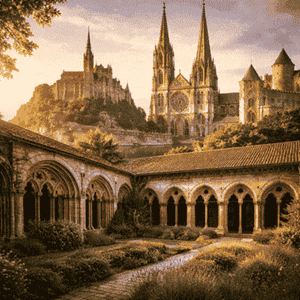
The Cloister of Bayonne Cathedral, one of the largest in France, is a Gothic haven of peace built in the 14th century. Its elegant galleries, with their soaring ribbed vaults, surround a light-filled central garden, offering a striking contrast to the bustle of the streets of Greater Bayonne. A UNESCO World Heritage Site, this masterpiece of golden stone testifies to the rich history of the Basque city during the period of English rule.
Wandering beneath its arcades, one discovers medieval tombs and exquisitely sculpted details that tell the story of daily and spiritual life in bygone days. The cloister serves as a link between the majestic cathedral and the former canons' buildings. It is a place for strolling, suspended in time, where the silence is broken only by the murmur of fountains, ideal for admiring the radiant architecture of the cathedral that overlooks it.
02. CLOITRE DE LA PSALETTE
Adjoining Tours Cathedral, the Cloister of the Psalette is a hidden gem that perfectly illustrates the transition between Flamboyant Gothic and French Renaissance styles. Built for the cathedral canons, its name evokes the psalms that were once sung there. This intimate space captivates visitors with the exquisite detail of its sculptures and its famous spiral staircase, whose openwork stone balustrade is a true architectural tour de force of the 16th century.
Wandering beneath its delicate vaults, one discovers a peaceful garden where time seems to stand still, far from the hustle and bustle of the city center. The galleries house exquisitely sculpted details, while the upper floor offers a breathtaking and unusual view of the cathedral's buttresses and stained-glass windows. It is an essential stop for lovers of Loire Valley history, offering a moment of calm and architectural elegance in the heart of Touraine.
03. CLOITRE DE LA CATHEDRALE DE BAYONNE
The Cloister of Bayonne Cathedral, one of the largest in France, is a Gothic haven of peace built in the 14th century. Its elegant galleries, with their soaring ribbed vaults, surround a light-filled central garden, offering a striking contrast to the bustle of the streets of Greater Bayonne. A UNESCO World Heritage Site, this masterpiece of golden stone testifies to the rich history of the Basque city during the period of English rule.
Wandering beneath its arcades, one discovers medieval tombs and exquisitely sculpted details that tell the story of daily and spiritual life in bygone days. The cloister serves as a link between the majestic cathedral and the former canons' buildings. It is a place for strolling, suspended in time, where the silence is broken only by the murmur of fountains, ideal for admiring the radiant architecture of the cathedral that overlooks it.