01. CHATEAUDE VOLTAIRE
A Refuge of Freedom of Expression
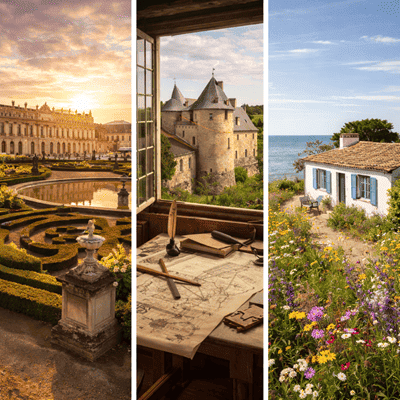
Located near the Swiss border, Voltaire's Château in Ferney is much more than a stately home: it was the headquarters of an intellectual revolution. Voltaire settled here in 1758 and spent the last twenty years of his life, transforming a modest hamlet into a thriving town. The château, rebuilt according to his plans, reflects the personality of its illustrious owner: elegant, open to the world, and intensely vibrant. It was here, in his study, that he wrote more than 6,000 letters and waged his most famous battles, such as the Treatise on Tolerance and the Calas Affair, making Ferney the intellectual capital of Enlightenment Europe.
The tour, completely redesigned by the Centre des Monuments Nationaux (National Monuments Centre), offers a sensory immersion into the philosopher's daily life. Visitors can discover his private apartments, his bed, as well as his art collections and interactive digital displays that bring his thought to life. The estate extends over a vast landscaped park that Voltaire, a passionate agronomist, designed himself. Strolling under the large hornbeam arbor where he liked to dictate his texts, the visitor feels the energy of a man who, between two gardens and two writings, laid the foundations of human rights and modern secularism.
02. MAISON EMILE ZOLA - MUSEE DREYFUS
The Lair of Naturalism and the Sanctuary of Justice
Located in the Yvelines department, the Médan estate bears witness to two revolutions: one literary, the other social. It was here that Émile Zola, thanks to the royalties from his novel L'Assommoir, acquired a small country house and transformed it into an imposing estate, flanked by the "Germinal" and "Nana" towers. For 24 years, Zola built his monumental work, the Rougon-Macquart series, here, surrounded by his Naturalist friends (Maupassant, Huysmans, Cézanne). The house remains a vibrant testament to his success, with its eclectic decor and stained-glass windows laden with symbolism.
Since 2021, the estate has also housed the Dreyfus Museum, the first and only museum in France dedicated exclusively to the Dreyfus Affair. Through a modern and poignant scenography, the museum retraces Zola's fight (author of the famous "J'Accuse…!") for the innocence of Captain Alfred Dreyfus. This place does more than simply display historical documents; it explores the values of the Republic, the fight against antisemitism, and the role of the intellectual in society. Visiting Médan is therefore to move from the private world of a great writer to the epicenter of a political earthquake that divided France and shaped its modern conscience.
03. MAISON D'ENFANCE D'ERNEST RENAN
A Journey to the Heart of the Breton Spirit
Located in the center of the medieval town of Tréguier, in the Côtes-d'Armor department, this imposing 16th-century half-timbered house is the birthplace of the writer, historian, and philosopher Ernest Renan. Born in 1823 in this family home, the author of *The Life of Jesus* drew his intellectual roots and Celtic sensibility from its very foundations. Transformed into a museum, the house retains an intimate and authentic atmosphere. The tour takes visitors through the furnished living rooms, the study, and, most notably, the faithful reconstruction of his office on the rue du Val-de-Grâce in Paris, creating a fascinating link between his native Brittany and his life as a scholar at the Collège de France.
More than just a place of remembrance, the house explores the complexity of Renan: from his religious training at the Tréguier seminary to his emancipation through science and reason. Visitors will discover manuscripts, personal belongings, and a wealth of iconography that illustrate his unwavering attachment to this "Land of Priests" and legends. The visit continues in a charming terraced garden, offering a bucolic respite with views over the city rooftops and the majestic Saint-Tugdual Cathedral, whose bells marked the rhythm of the writer's childhood.
04. MAISON DE GEORGE SAND
The Romantic Heart of Berry
In Nohant-Vic, the George Sand House is more than just a museum; it's a living, breathing home that seems to still await the return of its "good lady." It was in this family estate that the writer, born Aurore Dupin, found the inspiration for her most famous pastoral novels, such as *La Mare au Diable* (The Devil's Pool) and *La Petite Fadette*. A true haven for the intellectual and artistic elite of the 19th century, the house welcomed Frédéric Chopin, who composed many of his masterpieces there, as well as Gustave Flaubert, Eugène Delacroix, and Franz Liszt. Every room, from the grand salon to the guest bedrooms, retains the imprint of these passionate exchanges and this creative effervescence.
A visit offers a rare glimpse into the private world of a modern and audacious woman of letters. Here, you can discover her famous puppet theater, for which she meticulously sewed the costumes, as well as the dining room where the table is still set, ready to welcome her illustrious guests. The estate extends over six hectares of gardens, classified as a Remarkable Garden, where a formal French garden, an orchard, a rose garden, and a wooded park intertwine. Beneath the two majestic cedars planted by the writer at the birth of her children, one can feel the full force of the bond that united George Sand to her Berry region.