01. CATHEDRALE NOTRE DAME
A World Heritage Jewel
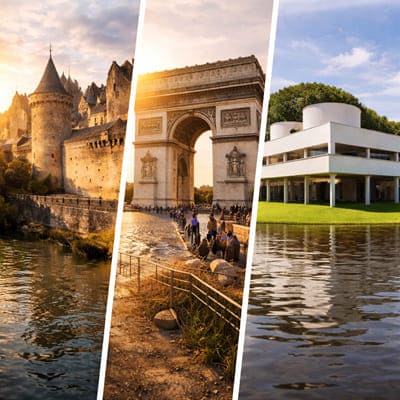
Built between the 12th and 14th centuries, Notre-Dame de Paris is much more than a religious monument; it is a privileged witness to the history of France. Famous for its monumental façade, spectacular rose windows, and gargoyles watching over the capital, it embodies the perfection of Rayonnant Gothic architecture. Following the tragic fire of 2019, the cathedral underwent an unprecedented restoration, revealing the golden hue of its limestone and the exquisite detail of its sculpted decorations.
Inside, the soaring vaults and the interplay of light through the stained-glass windows create an atmosphere of absolute serenity. Visitors can admire the historic grand organ, the cathedral treasury, and the tributes to Victor Hugo, whose novel greatly contributed to the building's worldwide renown. Located at the "Zero Point" of French roads, it remains the geographical and spiritual heart of Paris.
02. TOUR EIFFEL
Here is a tourist description of the Eiffel Tower, the ultimate emblem of France and its capital. The Eiffel Tower: The Iron Lady at the Top of Paris Inaugurated for the 1889 Universal Exposition, the Eiffel Tower is much more than a feat of wrought iron engineering; it is the universal symbol of Paris and French industrial genius. Rising 330 meters above the Champ de Mars, this audacious structure, conceived by Gustave Eiffel, offers three levels of exploration, each revealing a unique perspective on the City of Lights. The ascent begins on the first floor, with its vertigo-inducing glass floor, then continues to the second floor, renowned for offering the most unobstructed view of iconic monuments: the Louvre, Sacré-Cœur, and the Arc de Triomphe. Finally, the summit offers a more intimate and spectacular experience, allowing visitors to admire the reconstructed office of Gustave Eiffel while taking in the breathtaking horizon. As night falls, the tower transforms into a dazzling beacon, sparkling with a thousand lights every hour, enhancing its timeless magic. Whether for its intricate architecture or the unforgettable panorama it offers, it remains an essential stop for any traveler from around the world.
03. DOMAINE NATIONAL DE SAINT-CLOUD
A Balcony Overlooking Paris Overlooking the Seine and offering one of the most beautiful panoramas of the capital, the Domaine National de Saint-Cloud is a site steeped in rare historical significance. Although its château, the summer residence of the sovereigns and the birthplace of Napoleon I's coup d'état, was destroyed by fire in 1870, the imperial spirit remains intact in its gardens. A listed Historic Monument, this 460-hectare park designed by Le Nôtre is considered one of the most beautiful French formal gardens in Europe, blending grand vistas, secluded groves, and spectacular water features. Strolling through the estate is to discover the art of living at the royal and imperial courts. From the Grande Cascade, a masterpiece of 17th-century hydraulic architecture, to the Trocadéro Gardens, every path invites contemplation. The site is a veritable open-air museum where the statuary and the layout of the terraces recall that Saint-Cloud was, for centuries, the scene of the most sumptuous parties in the history of France, from Marie Antoinette to Napoleon III.
04. CHATEAU ROYAL D'AMBOISE
The Renaissance Balcony Perched on a rocky spur, the Château d’Amboise offers one of the most beautiful panoramas in the Loire Valley. A former residence of the kings of France, this monument marks a major turning point in history: it was here that Italian influence took firm root at court, transforming the medieval fortress into a Renaissance palace of exceptional refinement. A visit is a journey to the heart of royal power, from the richly furnished apartments to the imposing cavalier towers (the Tour des Minimes and the Tour Heurtault), whose gently sloping ramps once allowed horses and carriages direct access to the terraces. But the site is also inextricably linked to a universal figure: Leonardo da Vinci. Invited by Francis I, the Tuscan genius spent the last years of his life in Amboise and now rests in the Saint-Hubert Chapel, a jewel of Flamboyant Gothic sculpture suspended above the void. Between its Mediterranean gardens, its ramparts steeped in history and its sweeping views of the royal river, the Château d'Amboise perfectly embodies French elegance and art de vivre.