01. CITADELLE DE BONIFACIO
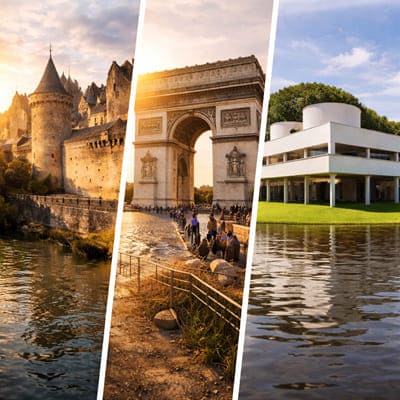
Enclosed within its fortifications, the medieval citadel is perched on a limestone promontory over 60 meters high, sculpted over millennia by the sea and wind. A veritable open-air museum, here you will find suggestions for visiting the citadel in a different way: a miniature train, a mobile app, and an audio guide are just some of the ways to explore its rich religious, military, and civil heritage. You can also find information on must-see monuments and all guided tours! The citadel of Bonifacio is a military structure built gradually from the 12th century onwards to protect Bonifacio, an important stronghold of the Republic of Genoa, ensuring the security of its trade between Genoa, Liguria, and Sardinia, and controlling the Strait of Bonifacio. It is referred to as the "citadel" of Bonifacio. Historians distinguish between a "citadel" and a "presidium," or "preside" in French. A preside is a fortified complex inhabited by a population tasked with defending the city and providing services there. A citadel has a purely military function. Bonifacio was the first presidency built by the Genoese in Corsica, at the end of the 12th century. Bonifacio is built on a limestone plateau with horizontal layers and a high cliff facing the sea, approximately 60 meters high.
02. DOMAINE NATIONAL DU CHATEAU D'ANGERS
An impregnable royal fortress. Built in the 13th century, the gigantic fortress of seventeen schist and limestone towers, stretching for nearly half a kilometer, exudes a formidable impression of power. In the 14th and 15th centuries, the enlightened Dukes of Anjou restored to Angers the splendor of court life, as evidenced by the site's refined architecture. A masterpiece unique in the world. Commissioned in 1375 by Duke Louis I, the Apocalypse Tapestry is, by virtue of its dimensions (100 meters long), its age, and its stylistic and technical virtuosity, an extraordinary masterpiece of medieval art. An illustration of the text of the Book of Revelation, it is also a remarkable document on the historical, social, and political context of its time and today belongs to the largest collection of cathedral tapestries in Europe. Remarkable gardens. A formal garden of boxwood and yew, a vineyard, a vegetable garden, a rose garden, a hydrangea garden, a hanging garden, and medicinal, dye, or even poisonous plants… History and innovation come together here in a sustainable development approach. From the top of the ramparts, enjoy a unique panoramic view of the city.
03. CITE DE CARCASSONNE
04. CHATEAU DE COUCY
The Stone Giant at the Gateway to Picardy
Proudly overlooking the Ailette Valley in the Aisne department, the Château de Coucy is one of the most spectacular testaments to feudal power in the Middle Ages. Built in the 13th century by Enguerrand III, a baron so powerful he defied royal authority, the castle was once flanked by the tallest keep in Christendom, reaching a height of 54 meters before its destruction in 1917. Today, its majestic ruins and 28 towers spread across a 2-kilometer perimeter still impress with their sheer scale. Wandering through this fortress is to delve into the history of the Coucy lineage, whose motto, "I am neither king, nor prince, nor duke, nor count; I am the lord of Coucy," perfectly encapsulates their boundless ambition.
A visit to this site, managed by the Centre des Monuments Nationaux, allows you to explore a maze of curtain walls, vaulted cellars, and high ramparts that offer breathtaking views of the medieval town of Coucy-le-Château-Auffrique. Recent restoration work provides a better understanding of medieval military engineering and the organization of a prestigious lordly court. Between hanging gardens and archaeological remains, the Château de Coucy is not just a romantic ruin; it's an open-air history book, ideal for a cultural getaway less than two hours from Paris.
05. TOURS DE LA ROCHELLE
Essential landmarks of La Rochelle, the Towers of La Rochelle—Saint-Nicolas, Chain Tower, and Lantern Tower—form one of the finest ensembles of medieval maritime fortifications in France. True icons of the Old Port, these three towers, listed as Historical Monuments, recount six centuries of turbulent history, from prosperous trade to religious wars and prison life. The Saint-Nicolas Tower, a veritable keep facing the open sea, and the Chain Tower, which once closed off access to the port, form a monumental gateway unique in the world, while the Lantern Tower, the last medieval lighthouse on the Atlantic coast, surprises with its Gothic spire and graffiti carved by imprisoned privateers.
Visiting these stone giants is like embarking on a breathtaking ascent into the past. Inside, vaulted rooms, hidden staircases, and museum exhibits immerse visitors in the atmosphere of a rebellious and independent city. But the highlight remains the 360° panorama from the ramparts: a breathtaking view of the Charente archipelago, Île d'Aix, Île d'Oléron, and the famous Fort Boyard. Whether you're passionate about military architecture or simply looking for the best view of the city, the Towers of La Rochelle offer an immersive experience between land and sea, in the heart of Charente-Maritime.
06. CHATEAU D'IF
A former fortress built under Francis I and later a dreaded state prison, the Château d'If is world-renowned thanks to Alexandre Dumas's novel, The Count of Monte Cristo. Isolated on its rocky islet off the coast of Marseille, it offers a stark and fascinating prison atmosphere, where the cells of famous and legendary prisoners can still be seen. Beyond the literary legend, the site offers a 360° view of Marseille, the Frioul Islands, and the Mediterranean Sea. It is a unique example of coastal military architecture, its walls still bearing graffiti etched by prisoners over the centuries.
07. FORTERESSE DE SALSES
The Brick Colossus at the Gates of Catalonia
Located at the foot of the Corbières mountains, the Salses Fortress is a unique monument, marking the fascinating transition between the medieval castle and the modern bastioned fortification. Built at the end of the 15th century by the Spanish Catholic Monarchs to block the French armies, it is striking for its brick and stone battleship-like appearance, literally embedded in the ground. Unlike medieval castles that sought height, Salses is built into the ground to offer the least possible target to cannonballs, an architectural revolution for its time. Its prodigiously thick walls (up to 12 meters) and deep moats made it a fortress renowned for being impregnable.
Exploring the interior of the fortress is a labyrinthine experience. Inside, one discovers a veritable garrison town capable of housing 1,500 men and hundreds of horses in complete self-sufficiency. The route leads from the vaulted stables to the bakeries, passing by the parade ground and the keep, a veritable castle within a castle. The ingenuity of the defensive system, with its narrow corridors and strategic arrow slits, testifies to the genius of Spanish military engineers. Now a national monument, Salses remains the steadfast guardian of the old border, offering a striking contrast between the power of its gleaming red structure and the azure blue of the Roussillon sky.
08. CITE FORTIFIEE DE AIGUES MORTES
The Medieval Pearl of the Camargue Rising like a mirage amidst salt marshes and lagoons, Aigues-Mortes is a masterpiece of 13th-century military architecture. Founded by King Saint Louis to provide the Kingdom of France with access to the Mediterranean, the city has preserved its entire fortified enclosure. Its 1,600 meters of ramparts form a perfect quadrilateral, punctuated by twenty towers and monumental gates, including the famous Constance Tower, which proudly overlooks the Gard landscape. Inside the walls, the medieval atmosphere blends with the gentle Provençal way of life. The cobbled streets, laid out in a grid pattern, converge on Place Saint-Louis, where café terraces and artisan shops cluster together. But the most striking spectacle is found right at the foot of the walls: the Salins du Midi, where the water is adorned with an intense pink thanks to a microscopic algae, creating an unreal contrast with the brilliant white of the salt mounds and the grey of the ancestral stones.
09. FORT SAINT-ANDRE
Fort Saint-André: The Royal Sentinel Facing Avignon
Dominating the town of Villeneuve-lez-Avignon from atop Mount Andaon, Fort Saint-André is a masterpiece of 14th-century military architecture. Built by the kings of France (Philip the Fair and then John the Good) to assert royal power against the Popes residing on the other side of the Rhône, this monumental fort impresses with its perfectly preserved walls and its gatehouse with massive twin towers. Much more than a simple barracks, the fort housed a veritable small town, of which the Abbey of Saint-André and its remarkable gardens remain today. Passing through its portcullises is like stepping back in time to the era when the Rhône marked the border between the Kingdom of France and the Holy Roman Empire.
A visit to the ramparts is a spectacular experience. Walking along the ramparts, you'll enjoy a breathtaking, sweeping view of the Palais des Papes, the famous Pont d'Avignon, and the distant peaks of Mont Ventoux and the Alpilles mountains. Inside the gatehouse, vaulted rooms and former prison cells, adorned with historical graffiti, bear witness to a turbulent past. Managed by the Centre des Monuments Nationaux, Fort Saint-André is a must-see for lovers of medieval history and photography, offering an Olympian calm and sublime Provençal light, far removed from the tourist bustle of its neighbor, Avignon.
10. CHATEAU DAUPHIN
The Sentinel of the Auvergne Volcanoes
Located in Pontgibaud, in the Puy-de-Dôme department, Château Dauphin is one of the finest examples of medieval military architecture in Lower Auvergne. Built in the 12th century by Robert Dauphin, Count of Clermont, to control the Sioule Valley, this fortified castle impresses with its massive structure of lava stone (andesite), which gives it the characteristic gray color of buildings in the region. Unlike many fortresses transformed during the Renaissance, Château Dauphin has retained its proud defensive appearance with its circular keep, curtain walls, and six towers, all perfectly restored. Still inhabited by the same family since 1756, it offers an intimate glimpse into the history of the Auvergne nobility.
A visit to Château Dauphin is a journey through a richly furnished interior where historical mementos mingle with a unique collection of objects related to the silver-lead mines of Pontgibaud, which once brought wealth to the region. The tour takes you through state rooms, a monumental kitchen, and private apartments that exude authenticity. But the charm of the site also lies in its grounds: its listed historic kitchen garden, a true French formal garden, offers a delicate contrast between the starkness of the lava stone and the lushness of the flower and vegetable gardens. It is a major cultural and botanical destination at the foot of the Chaîne des Puys, a UNESCO World Heritage Site.