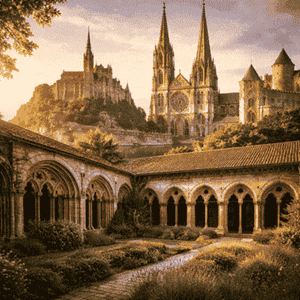
01. CITE DE CARCASSONNE
02. PONT DU GARD ET MUSEE
The Pont du Gard is a three-tiered bridge built to carry a Roman aqueduct. It is located in Vers-Pont-du-Gard, between Uzès and Remoulins, near Nîmes, in the French department of Gard. It spans the Gardon River. Probably built in the first half of the 1st century, it ensured the continuity of the Roman aqueduct that carried water from Uzès to Nîmes. According to recent research, it ceased to be used at the beginning of the 6th century.
03. SALINE ROYALE
Pierre Ledoux's Utopia Located in the Doubs region, the Royal Saltworks is an absolute masterpiece of industrial architecture and a testament to a utopian dream. Built between 1775 and 1779 by Claude-Nicolas Ledoux, the visionary architect of King Louis XV, it was intended for the production of salt, the "white gold" of the time. Designated a UNESCO World Heritage Site in 1982, it is distinguished by its perfect semicircle, a shape designed to facilitate monitoring but also to symbolize the sun's path. It is one of the most spectacular sites in Burgundy-Franche-Comté. The site is not only worth visiting for its industrial history. Ledoux envisioned an ideal city here, the town of Chaux, of which the Saltworks was only the first element. Today, you can explore the immense production buildings (the barns), the Director's House with its monumental architecture, and the themed gardens that now occupy the former workers' vegetable plots. The site has become a major cultural center, blending architectural exhibitions, garden festivals, and concerts, offering an experience where neoclassical rigor meets contemporary creativity.
04. PALAIS DU TAU
Located next to Reims Cathedral, the Palais du Tau is the former episcopal palace where the kings of France stayed during their coronations. Its unusual name comes from its plan, which resembles the Greek letter "T" (Tau). Rebuilt in the 17th century, it retains a magnificent 12th-century lower hall and a Gothic palatine chapel, offering a unique glimpse into the history of the French monarchy and the splendor of royal ceremonies.
Now a museum, it houses the fabulous Treasury of Reims Cathedral, including Charlemagne's talisman and the coronation chalice. Visitors can also admire the cathedral's monumental tapestries and original statues, which were removed for preservation. A visit to the Palais du Tau is an essential part of any visit to the cathedral for anyone wishing to understand the national significance of the "City of Coronations."
05. TOUR PEY-BERLAND DE BORDEAUX
A solitary stone sentinel on Place Pey-Berland, the Pey-Berland Tower is the independent bell tower of Bordeaux's Saint-André Cathedral. Erected in the 15th century in the Flamboyant Gothic style, it was built separately to protect the main building from the vibrations of the heavy bells. Crowned with a gilded statue of Our Lady of Aquitaine, this slender tower is one of Bordeaux's most beloved heritage symbols, a UNESCO World Heritage Site.
Climbing its 231 steps offers a physical challenge rewarded by an unforgettable view. From its exterior galleries, one discovers a 360° panoramic view of the pink-tiled rooftops, the spire of Saint-Michel, and the majestic curves of the Garonne River. It is the ideal vantage point to understand the urban layout of the "Sleeping Beauty" and admire the architectural details of the cathedral's buttresses, which one overlooks from a breathtaking vantage point.
06. LA MAISON CARREE
The Splendor of the Augustan Age A UNESCO World Heritage Site since 2023, the Maison Carrée is the best-preserved Roman temple in the world. Erected at the very beginning of our era (between 2 and 5 AD), this building was dedicated to the imperial cult, and more specifically to Lucius and Gaius Caesar, the grandsons and heirs of Emperor Augustus. What strikes you upon arrival in the square is its exceptional state of preservation: its thirty Corinthian columns and its frieze of acanthus leaves seem to have survived two millennia without a wrinkle. Contrary to what its name suggests, it is rectangular (the term "square" formerly referred to a shape with right angles). Its architecture, known as pseudo-peripteral, rests on a high, typically Roman podium. This monument is not merely an ancient relic; it is the beating heart of Roman culture in Nîmes. Inside, the cella (the sacred room) now houses a renewed museography and models allowing visitors to understand the history of the monument, from its ancient religious function to its multiple lives (consular house, church, then museum).
07. ABBAYE DE LA SAUVE-MAJEURE
Built in the 11th century amidst a vast forest (silva major), the Abbey of La Sauve-Majeure is striking for the majesty of its open-air ruins. This jewel of the Gironde region was a key stop on the Way of St. James (Camino de Santiago). Its light-filled remains offer exceptional testimony to the religious and artistic influence of the Benedictine order in Aquitaine.
The abbey's renown rests on the incredible richness of its sculpted capitals, among the best preserved in France. These sculptures depict biblical scenes and fantastical creatures with captivating precision. Climbing to the top of the bell tower offers a 360° view of the rolling vineyards of the Entre-deux-Mers region, harmoniously blending stone heritage and wine-growing landscapes.
08. CITE MEDIVALE DE PROVINS
A Journey to the Heart of the Middle Ages A true jewel of French heritage, a UNESCO World Heritage Site, the medieval town of Provins transports its visitors back to the 12th century, to the time of the famous Champagne Fairs. Passing through its imposing fortified gates, you discover a picture-perfect setting: spectacular ramparts stretching for over a kilometer, picturesque cobbled streets, and half-timbered houses that tell the story of centuries of commercial and military history. The experience doesn't end with a simple stroll. The upper town is dominated by the majestic Caesar's Tower, the only octagonal keep with a square base, offering a unique panoramic view of the surrounding countryside. Between visiting the mysterious underground passages and exploring the Tithe Barn, Provins is a must-see destination for architecture enthusiasts and families seeking a historical escape just an hour from Paris.