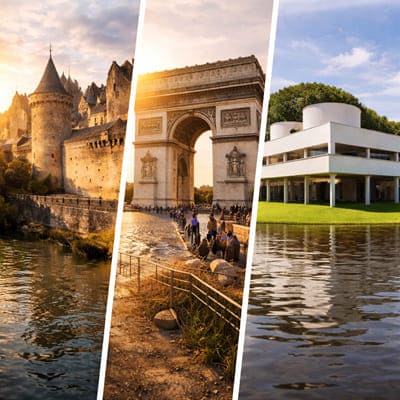
01. TOUR EIFFEL
Here is a tourist description of the Eiffel Tower, the ultimate emblem of France and its capital. The Eiffel Tower: The Iron Lady at the Top of Paris Inaugurated for the 1889 Universal Exposition, the Eiffel Tower is much more than a feat of wrought iron engineering; it is the universal symbol of Paris and French industrial genius. Rising 330 meters above the Champ de Mars, this audacious structure, conceived by Gustave Eiffel, offers three levels of exploration, each revealing a unique perspective on the City of Lights. The ascent begins on the first floor, with its vertigo-inducing glass floor, then continues to the second floor, renowned for offering the most unobstructed view of iconic monuments: the Louvre, Sacré-Cœur, and the Arc de Triomphe. Finally, the summit offers a more intimate and spectacular experience, allowing visitors to admire the reconstructed office of Gustave Eiffel while taking in the breathtaking horizon. As night falls, the tower transforms into a dazzling beacon, sparkling with a thousand lights every hour, enhancing its timeless magic. Whether for its intricate architecture or the unforgettable panorama it offers, it remains an essential stop for any traveler from around the world.
02. MUSEE DU LOUVRE
The Louvre Museum: The Universal Sanctuary of the Arts Once the residence of the kings of France, the Louvre is today the world's largest art and antiquities museum. Its iconic silhouette, where I.M. Pei's glass pyramid meets Renaissance façades, symbolizes a Paris that reconciles history and modernity. Inside, the galleries extend over more than 70,000 square meters, housing priceless treasures such as the Mona Lisa, the Venus de Milo, and the colossal winged bulls of Khorsabad. Exploring the Louvre is like traversing 10,000 years of civilization, from the splendors of ancient Egypt to the masterpieces of European painting. But the Louvre is also an inexhaustible backdrop for the world of cinema. Film buffs will remember Jean-Paul Belmondo's boundless energy as he raced through the galleries in a legendary scene from the film *Bande à part* (a reference later used by Godard and many others). This blend of the solemnity of the artworks and the vitality of popular culture makes the Louvre a vibrant place, far removed from the dusty museum image. A breathtaking visit that requires several stops, given the boundless richness of the collections.
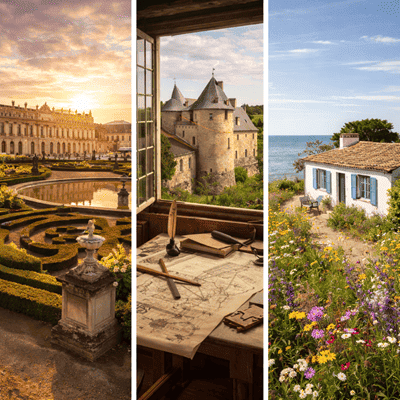
03. CHATEAU DE VERSAILLES
04. ABBAYE DU MONT SAINT MICHEL
Rising from the sands of the bay, Mont-Saint-Michel Abbey is an architectural marvel that has defied the elements for over a millennium. This sanctuary, dedicated to the Archangel Saint Michael, is a masterful blend of styles, ranging from Romanesque to Flamboyant Gothic. The visit culminates in the cloister, suspended between sky and sea, and in the Hall of the Marvel, a jewel of monastic architecture. Beyond its religious significance, this granite labyrinth has always captivated filmmakers. Its imposing fortress-like appearance has served as the backdrop for numerous cinematic productions. Notably, it evokes the spirit of Jean-Paul Belmondo in The Inheritor, where the monumental aesthetic of the Mont underscores the power of the narrative. Between the vertiginous staircases and the terraces offering panoramic views of the highest tides in Europe, the abbey provides an extraordinary sensory and historical experience. Listed as a UNESCO World Heritage Site, it remains the eternal symbol of the alliance between human ingenuity and wild nature.
05. CITE DE CARCASSONNE
06. CHATEAU DU HAUT-KOENIGSBOURG
Haut-Kœnigsbourg Castle is a 12th-century Alsatian fortress, extensively remodeled in the 15th century and restored before the First World War under William II. The castle stands in the French commune of Orschwiller in the Bas-Rhin department of the Grand Est region, within the historical and cultural region of Alsace. The castle's current name, Haut-Kœnigsbourg, is an adaptation of the German name Hochkönigsburg, which translates as "high castle of the king." Immerse yourself in the world of the Middle Ages. From the lower courtyard with its inn, forge, and mill, to the spiral staircases leading to the lord's furnished apartments, discover architecture, furnishings, and an atmosphere steeped in history.
07. CHATEAU DE CHAMBORD
Built in the heart of the largest enclosed forest park in Europe (approximately 50 km² surrounded by a 32 km long wall), it is the largest of the Loire Valley châteaux. It boasts a formal garden and a hunting park, both listed as historical monuments. Chambord is the only royal estate that remains intact since its creation.
08. CATHEDRALE DE STRASBOURG
Strasbourg Cathedral is a Gothic Catholic cathedral located in Strasbourg, Alsace. Founded in 1015 on the remains of an earlier cathedral, it was built from 1220 onwards by the Free City of Strasbourg, a wealthy merchant and financial republic, in the Gothic style. Since 1988, it has been the seat of its own archdiocese. Today, it is the second most visited cathedral in France, after Notre-Dame de Paris, attracting eight and a half million tourists annually. In 2019, it was voted the most beautiful cathedral in France by Memes Décentralisés. Virtually completed in 1365, it is unique in that the space between its two towers was filled in 1388, and it is recognizable by its single bell tower, topped by a spire added in 1439. Between 1647 and 1874, for more than two centuries, it was the tallest building in the world (142 meters high). Today, it is the tallest cathedral in the Grand Est region and the second tallest in France after Rouen. It is also the fifth tallest cathedral in the world. This "prodigy of the gigantic and the delicate," admired by Victor Hugo and celebrated by Goethe, who experienced his first loves there, is visible from afar across the Alsatian plain, and even from the Vosges Mountains and the Black Forest. Adjacent to the building of the Fondation de l'Œuvre Notre-Dame and the Rohan Palace, it stands in Cathedral Square, in the heart of Strasbourg's historic center.
09. PONT DU GARD ET MUSEE
The Pont du Gard is a three-tiered bridge built to carry a Roman aqueduct. It is located in Vers-Pont-du-Gard, between Uzès and Remoulins, near Nîmes, in the French department of Gard. It spans the Gardon River. Probably built in the first half of the 1st century, it ensured the continuity of the Roman aqueduct that carried water from Uzès to Nîmes. According to recent research, it ceased to be used at the beginning of the 6th century.
10. CHATEAU CHENONCEAU
Chenonceau, with its famous two-story gallery overlooking the Cher River, is one of the jewels of Loire Valley architecture. Its Italian influences and French characteristics are clearly visible. Of the original building, only the Tour des Marques remains today, a vestige of the medieval castle that borders the Cher. Chenonceau was built, furnished, and transformed by women of very different temperaments. It was built by Katherine Briaçonnet in 1513, enriched by Diane de Poitiers, and enlarged under Catherine de Medici. It became a place of retreat under the White Queen Louise of Lorraine, then it was saved by Louise Dupin during the French Revolution, and finally, transformed by Madame Pelouze. Due to the large number of women who have been in charge of it, it is nicknamed "the Ladies' Castle." The private estate of Chenonceau has belonged to the Menier family since 1913 and is open to the public. The castle has been listed as a historical monument since its initial inscription on the list in 1840, and the park by decree dated November 7, 1962. The building and its surroundings have been part of the Loire Valley, a UNESCO World Heritage Site, since July 9, 2017.