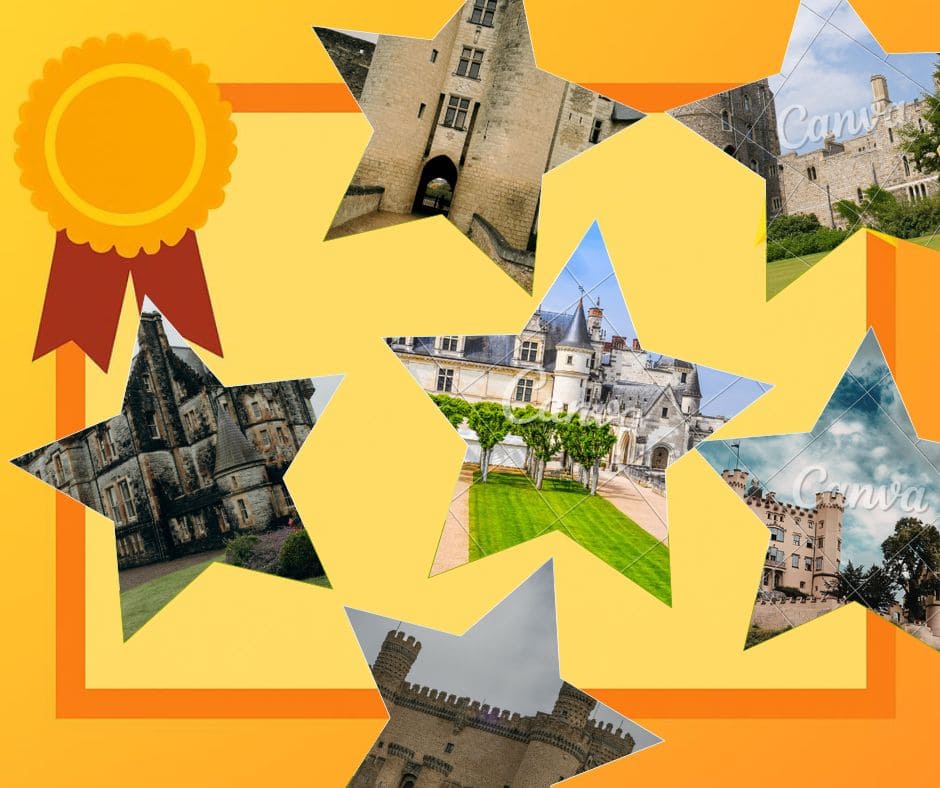
01. CHATEAU DE CHANTILLY
A royal getaway in the heart of France. Escape for a day to this exceptional château, a true jewel of French heritage. From the Musée Condé, home to priceless art collections, to the Great Stables, a tribute to the horse, and the formal French gardens, Chantilly offers a unique experience. Immerse yourself in the history of this princely residence and let yourself be captivated by its timeless charm.
02. CHATEAU CATHARE DE PEYREPERTUSE
Peyrepertuse Castle is a Cathar fort located in Duilhac-sous-Peyrepertuse in the Aude department. It is called the "Celestial Carcassonne" because it is as large as Carcassonne itself. From its rocky spur, it offers a breathtaking view of a neighboring Cathar castle: Quéribus. It is the very embodiment of one of the most beautiful Cathar fortresses. This fort is a remarkable example of medieval military architecture in the Languedoc region. The view of the castle from Duilhac (to the south) is impressive due to the 30- to 40-meter cliff on which it stands. The main entrance is on the north side, but in Cathar times, a secret passage, accessed via a removable ladder, allowed entry to the castle after a narrow path behind a large rocky spur. Today the postern gate of the secret passage is closed, but the path is still there (the passage behind the spur is exceptional) and it is possible to finish the climb with a climbing route.
03. CHATEAU DU HAUT-KOENIGSBOURG
Haut-Kœnigsbourg Castle is a 12th-century Alsatian fortress, extensively remodeled in the 15th century and restored before the First World War under William II. The castle stands in the French commune of Orschwiller in the Bas-Rhin department of the Grand Est region, within the historical and cultural region of Alsace. The castle's current name, Haut-Kœnigsbourg, is an adaptation of the German name Hochkönigsburg, which translates as "high castle of the king." Immerse yourself in the world of the Middle Ages. From the lower courtyard with its inn, forge, and mill, to the spiral staircases leading to the lord's furnished apartments, discover architecture, furnishings, and an atmosphere steeped in history.
04. CHATEAU DES DUCS DE BRETAGNE
The Château des Ducs de Bretagne is a defensive and pleasure castle located in Nantes, in the Loire-Atlantique department of France. Classified as a historical monument since 1840, it was primarily built in the 15th century but also includes elements dating from the 14th to the 18th centuries. Founded by the Dukes of Brittany in the 13th century as a defensive base in Nantes, the castle became, under Francis II, the principal Breton ducal residence. Its military function was also used by the Duke during the Mad War, in which he opposed the King of France. His daughter, Duchess Anne, was later forced to marry two successive French kings, Charles VIII and Louis XII. These marriages led to the union of Brittany with France, definitively sealed by an edict signed at the castle in 1532 by Francis I. From then on, the castle lost its status as a ducal residence and became a royal fortress. It witnessed the passage of most French kings when they visited Brittany, and it served as the official residence of the province's governors. Nevertheless, their stays were generally brief, with the notable exception of the Duke of Mercoeur, a governor who held court there during the Wars of Religion. Under the Ancien Régime, the castle also served as a state prison, and especially as a barracks and military arsenal. It suffered no damage during the Revolution, but the explosion of the gunpowder stores in 1800 destroyed a significant portion of the structure. In the 19th century, the castle retained its military function, but its heritage value was gradually recognized, and some restoration work was undertaken. Owned by the city of Nantes from 1915, it became a museum in 1924. From 1990 to 2007, it underwent a major renovation and since 2007 it has housed the Nantes History Museum.
05. CHATEAU DE GRIGNAN
Perched on a rocky promontory overlooking the lavender fields and vineyards of the Drôme Provençale, the Château de Grignan is a Renaissance masterpiece in Southern Europe. Originally a medieval fortress, it was transformed in the 16th century into a sumptuous residential palace by the Adhémar family. The château entered literary history thanks to the Marquise de Sévigné, who stayed there for extended periods with her daughter, the Countess of Grignan, and wrote much of her famous correspondence there. The château's architecture is particularly impressive, notably its monumental terrace, one of the largest in France, which offers a 360-degree panorama stretching from Mont Ventoux to the Prealps. After being dismantled during the French Revolution, the château was magnificently rebuilt in the early 20th century by a wealthy patron, Marie Fontaine. Today, the state rooms feature remarkable period furniture and antique tapestries. In the summer, the main courtyard becomes the setting for prestigious performances under the stars.