01. CHATEAU DU HAUT-KOENIGSBOURG
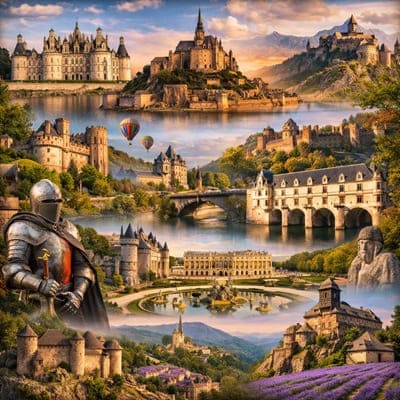
Haut-Kœnigsbourg Castle is a 12th-century Alsatian fortress, extensively remodeled in the 15th century and restored before the First World War under William II. The castle stands in the French commune of Orschwiller in the Bas-Rhin department of the Grand Est region, within the historical and cultural region of Alsace. The castle's current name, Haut-Kœnigsbourg, is an adaptation of the German name Hochkönigsburg, which translates as "high castle of the king." Immerse yourself in the world of the Middle Ages. From the lower courtyard with its inn, forge, and mill, to the spiral staircases leading to the lord's furnished apartments, discover architecture, furnishings, and an atmosphere steeped in history.
02. CHATEAU FORT DE SEDAN
An Impregnable Fortress
Spread over seven levels and covering an area of 35,000 m², the Château Fort de Sedan is a masterpiece of military architecture. Built starting in 1424 by Évrard de La Marck, it was continually expanded over the centuries to adapt to advancements in artillery. Its walls, reaching thicknesses of over 25 meters in places, bear witness to its defensive purpose: protecting the principality of Sedan against the ambitions of neighboring great powers. Unlike many castles transformed into pleasure residences during the Renaissance, Sedan has retained its massive and warlike appearance, still intimidating anyone who crosses its moat today.
Exploring the site immerses visitors in the private world of the Princes of Sedan. Wandering along the curtain walls and bastions, one discovers an ingenious defensive system, as well as traces of a refined court life within the princely apartments. The castle has survived the ages, from the Hundred Years' War to the capitulation of Napoleon III in 1870, without ever being taken by force. Today, its wide terraces offer a breathtaking view of the Meuse River and the city, making this stone sentinel the beating heart of Ardennes culture.
03. CHATEAU DE LUNEVILLE
Lunéville Castle, a possession of the Dukes of Lorraine since the 13th century, was built for Duke Leopold I between 1703 and 1720 based on plans by Pierre Bourdict, Nicolas Dorbay, and Germain Boffrand. Lunéville Castle offers a remarkable glimpse into the 18th century. Following the devastating fire of winter 2003, the castle was the largest restoration project in Europe until 2010. Currently, you can experience a musical journey retracing the history of the castle and its iconic figures in areas that have been restored since the 2003 fire.
04. CHATEAU DE HAROUE
Nicknamed the "Versailles of Lorraine," the Château de Haroué is a marvel of 18th-century French architecture. Its design is an ode to the calendar: it boasts four towers for the seasons, twelve turrets for the months, fifty-two chimneys for the weeks, and 365 windows for the days. Built by the architect Germain Boffrand for the Prince of Beauvau-Craon, it is unique in that it was erected on the foundations of an earlier medieval castle, whose moat and corner towers it has preserved. The château is still inhabited by the Beauvau-Craon family, ensuring an authentic and refined atmosphere. The interior decorations are exceptionally rich, featuring woodwork by Jean Lamour (the ironworker of Place Stanislas in Nancy) and tapestries from the Meurthe Manufactory. The gardens, designed by renowned landscape architects, offer magnificent French-style vistas that underscore the perfect harmony of the building.
05. CHATEAU DE LA MOTTE TILLY
The Château de La Motte-Tilly is a stunning illustration of 18th-century French refinement, located in the heart of the Aube department. Built in 1754 for Abbé Terray, King Louis XV's finance minister, this elegant residence stands as a masterpiece of neoclassical architecture. Its symmetrical facade of brick and stone overlooks a sprawling 60-hectare estate, designed for the ultimate "countryside retreat" of the French nobility. The castle's timeless beauty even caught the eye of Hollywood, serving as a key filming location for Milos Forman's Dangerous Liaisons.
Inside, the castle houses an extraordinary collection of period furniture and fine arts, preserved exactly as they were by the Marquise de Maillé. Each room, from the grand salon to the intimate libraries, reflects the sophisticated lifestyle of the Enlightenment. The outdoor experience is equally captivating, featuring formal French gardens, an English-style park, and a magnificent "water mirror" reflecting the sky and the castle’s architecture. It is a peaceful and aristocratic escape, just a short drive from Paris.