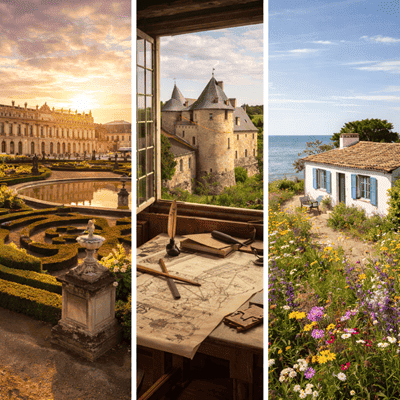

01. CHATEAU DE VERSAILLES
02. CHATEAU CHENONCEAU
Chenonceau, with its famous two-story gallery overlooking the Cher River, is one of the jewels of Loire Valley architecture. Its Italian influences and French characteristics are clearly visible. Of the original building, only the Tour des Marques remains today, a vestige of the medieval castle that borders the Cher. Chenonceau was built, furnished, and transformed by women of very different temperaments. It was built by Katherine Briaçonnet in 1513, enriched by Diane de Poitiers, and enlarged under Catherine de Medici. It became a place of retreat under the White Queen Louise of Lorraine, then it was saved by Louise Dupin during the French Revolution, and finally, transformed by Madame Pelouze. Due to the large number of women who have been in charge of it, it is nicknamed "the Ladies' Castle." The private estate of Chenonceau has belonged to the Menier family since 1913 and is open to the public. The castle has been listed as a historical monument since its initial inscription on the list in 1840, and the park by decree dated November 7, 1962. The building and its surroundings have been part of the Loire Valley, a UNESCO World Heritage Site, since July 9, 2017.
03. CHATEAU DE PIERREFONDS
The Medieval Ideal Reinvented Rising from dense forests like a mirage, the Château de Pierrefonds offers the purest and most imposing image of a medieval fortress. Yet, this stone colossus is the product of a unique architectural adventure: left in ruins by history, it was entirely rebuilt in the 19th century by the audacious Viollet-le-Duc under the impetus of Napoleon III. More than a simple restoration, it is a masterful interpretation of medieval architecture, blending defensive realism with decorative fantasy. With its eight massive towers, crenellated curtain walls, and incredible defensive system, the exterior impresses with its power. Inside, visitors discover a magical world: the Hall of Heroines, an immense gallery with painted and sculpted decorations, testifies to the imperial luxury and chivalric ideals of the era. This dreamlike setting, a blend of historical reality and theatrical scenery, has naturally captivated the world of film and television (notably for the Merlin series). A visit to Pierrefonds is a fascinating journey into the land of legends, knights, and French architectural genius.
04. CHATEAU DE JOSSELIN
Dominating the Oust Valley, Josselin Castle has been the residence of the Rohan family for over a thousand years. It is a building of two faces: from the river, one admires an impregnable fortress with three massive towers and steep ramparts. But as soon as one enters the main courtyard, one discovers a sculpted granite façade of incredible finesse, a masterpiece of Breton Flamboyant Gothic, adorned with ornate dormer windows and heraldic mottos. The interiors, renovated in the 19th century in a sumptuous Neo-Gothic style, house rich collections of furniture and historical memorabilia. The grounds are equally enchanting, with their renowned rose garden (more than 160 varieties), formal French gardens, and English landscape park. In the former stables, the castle houses an exceptional museum of dolls and antique toys, drawn from the Rohan family's private collection.
05. CHATEAU FORT DE ROQUETAILLADE
Roquetaillade is a unique case: it comprises two fortified castles within the same enclosure, inhabited by the same family for 700 years. While the exterior is a classic medieval fortress, the interior was completely transformed by the renowned architect Viollet-le-Duc in the 19th century. The decorations, furnishings, and paintings are breathtakingly exuberant in the Neo-Gothic style. The castle is still a working farm (producing Graves wine) and offers an immersive experience in a living residence, where medieval history meets the comfort and visionary style of the 19th century.
06. CHATEAU DE BAZOCHES
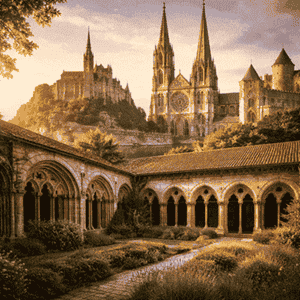
Dominating the village of Bazoches with its four round towers, this castle was the home of Marshal Vauban, the renowned military engineer of Louis XIV. It was here that he designed the plans for over 300 citadels and fortresses throughout France. The castle, built in the 12th century, was transformed by Vauban into a veritable design office, complete with a 30-meter-long gallery where his engineers and draftsmen worked. The interior has remained very personal: visitors can discover the Marshal's bedroom, his study, and numerous family mementos, as the castle is still inhabited by his descendants. The atmosphere is warmer and more studious than in the grand royal palaces. From the windows, the view of the Morvan hills and the Vézelay Basilica in the distance is absolutely breathtaking.
07. CHATEAU DE TARASCON
This fortress, one of the most spectacular in France, is striking first and foremost for its remarkable architectural contrast: a massive exterior reminiscent of a medieval castle conceals within its heart a royal residence of exquisite refinement. Built in the 15th century by the Dukes of Anjou, its high walls of golden limestone rise directly above the river, presenting an image of power that seems untouched by time. Inside, the main courtyard reveals sculpted decorations in the Flamboyant Gothic style, reflecting the artistic taste of René of Anjou, the "Good King." Visitors can explore impressively sized vaulted rooms, ancient apothecaries, and princely apartments where the Provençal light plays across the intricate details of the stonework. The castle is also a vibrant center for art, regularly hosting contemporary art exhibitions that create a fascinating dialogue between millennia of history and modern creation. From a culinary perspective, the Tarascon region is a crossroads between Provence and the Camargue. Local restaurants showcase bull stew, herbs from the garrigue, and olive oil from the Vallée des Baux. For those with a sweet tooth, tradition dictates ending the meal on a sweet note with Tartarinades, biscuits or chocolates inspired by the illustrious character of Alphonse Daudet, an emblem of the town's jovial and boastful spirit.
08. CHATEAU DU HAUT-KOENIGSBOURG
Haut-Kœnigsbourg Castle is a 12th-century Alsatian fortress, extensively remodeled in the 15th century and restored before the First World War under William II. The castle stands in the French commune of Orschwiller in the Bas-Rhin department of the Grand Est region, within the historical and cultural region of Alsace. The castle's current name, Haut-Kœnigsbourg, is an adaptation of the German name Hochkönigsburg, which translates as "high castle of the king." Immerse yourself in the world of the Middle Ages. From the lower courtyard with its inn, forge, and mill, to the spiral staircases leading to the lord's furnished apartments, discover architecture, furnishings, and an atmosphere steeped in history.
09. CHATEAU DE QUERIBUS
Standing defiantly against the sky at an altitude of 728 meters, Quéribus Castle is a masterpiece of medieval military engineering. Known as one of the "Five Sons of Carcassonne," this fortress served as the final refuge for the Cathars during the Albigensian Crusade, holding out until 1255. Its historical significance is deeply rooted in its role as a strategic border post between the Kingdom of France and Aragon. Visiting Quéribus is not just a tour; it is a journey back to the turbulent era of religious wars and royal expansion.
The architectural layout of the citadel is a feat of engineering, seamlessly blending stone with the jagged limestone cliffs. The highlight of the structure is the "Pillar Room" (Salle du Pilier) inside the great keep. Here, a magnificent Gothic palm-shaped pillar supports the vaulted ceiling, showcasing a surprising elegance amidst the rugged defensive walls. From the terrace of the keep, visitors are rewarded with a 360-degree panorama stretching from the Mediterranean Sea to the snowy peaks of the Pyrenees.