
Key Dates
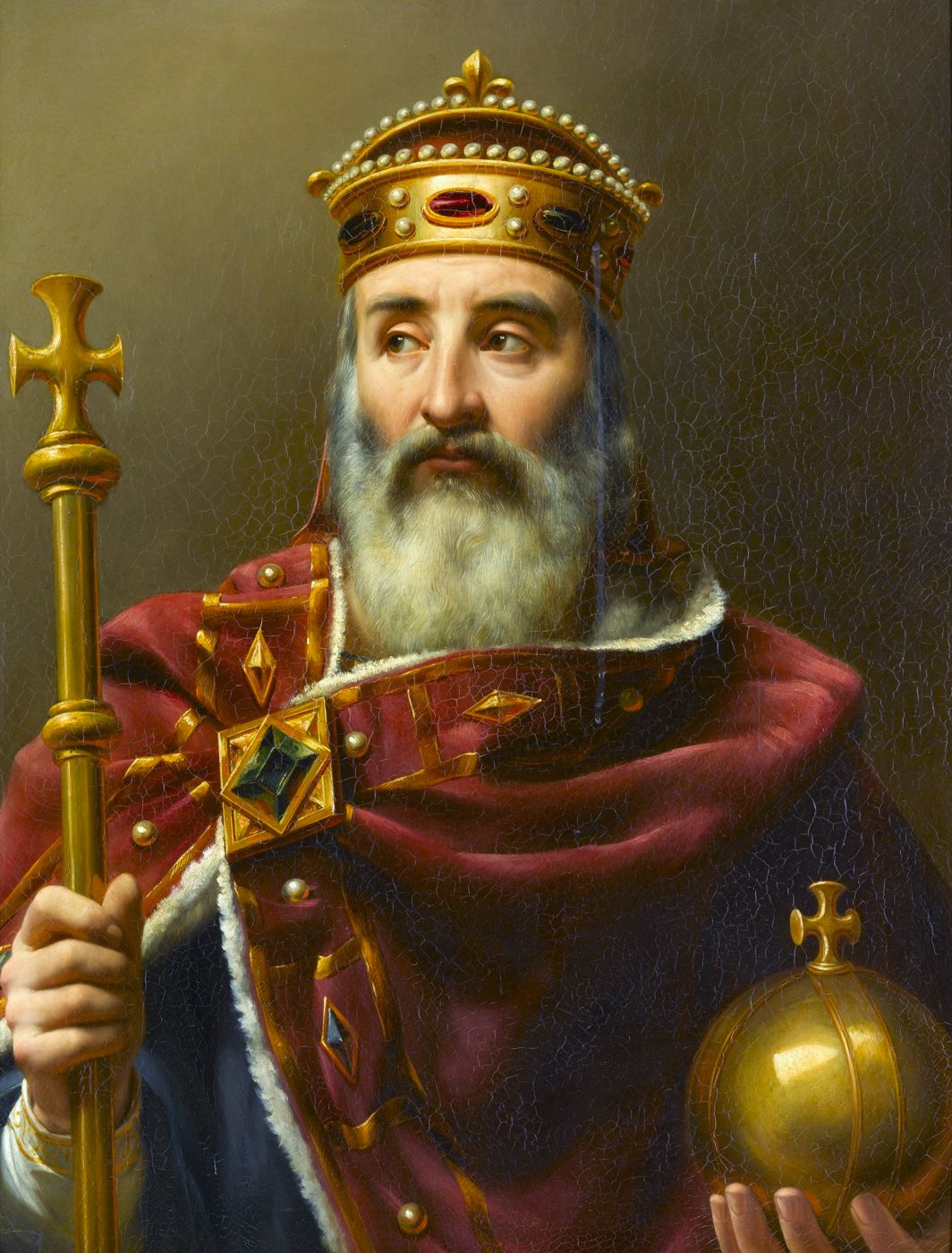
CHARLEMAGNE
"Empereur des Romains "
Born around 742 or 748, the son of Pepin the Short and Bertha Broadfoot, Charlemagne belonged to the Carolingian dynasty. Upon his father's death in 768, he initially shared the kingdom with his brother Carloman. It was only after Carloman's death in 771 that he became the sole ruler of the Franks. A tireless warrior of imposing stature, he immediately embarked on a series of military campaigns aimed at converting pagans and expanding his borders. His reign was marked by unprecedented territorial expansion, subjugating the Lombards in Italy, the Saxons in Germany, and the Avars in Central Europe. The Restoration of the Western Roman Empire The zenith of his power came on Christmas Day in the year 800. In Rome, Pope Leo III crowned him "Emperor of the Romans," a title that had not been used in the West for over three centuries. This event is pivotal: it marks the birth of a new Christian political space that aspired to be the heir of ancient Rome. To govern this vast territory stretching from the Elbe to the Ebro, Charlemagne relied on a centralized administration in Aachen and sent his "missi dominici" (envoys of the lord) to oversee the counts and ensure that his orders were implemented everywhere. The Carolingian Renaissance Beyond conquests, Charlemagne was the architect of a major cultural and educational renewal. Aware that force alone was insufficient for the unity of the empire, he surrounded himself with the greatest scholars of his time, such as Alcuin, and encouraged the creation of schools to train the leaders of the Church and the State. It was under his impetus that the use of "Carolingian minuscule," a clear and legible script that facilitated the copying of manuscripts and the dissemination of knowledge, became widespread. Although he himself struggled with writing, he fostered the arts, architecture, and the unification of the liturgy, laying the intellectual foundations of medieval Europe. A Shared Legacy Charlemagne died in 814 in Aachen, leaving behind a vast but fragile empire. His son, Louis the Pious, managed to maintain its unity, but in 843, the Treaty of Verdun divided the empire among his three grandsons. This partition foreshadowed the future borders of France and Germany. Despite this political fragmentation, the figure of Charlemagne remained a powerful myth throughout the Middle Ages, for both the French and the Germans. He remained the symbol of European unity and the legendary protector of education and Christianity.