
Key Dates
FRANCOIS Ier
"Roi-Chevalier"
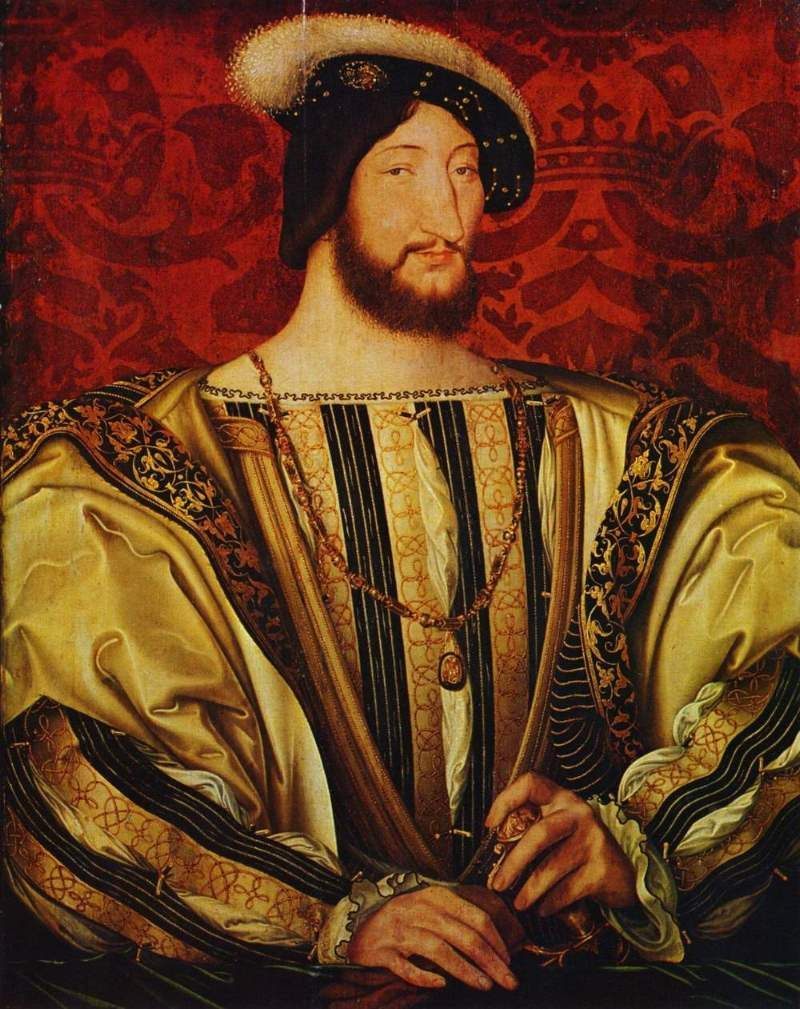
Born in 1494 in Cognac, Francis of Angoulême was only a cousin of King Louis XII, but the lack of a direct male heir propelled him to the throne in 1515. Young, athletic, and highly cultured, he ideally embodied the spirit of the Renaissance. From the very beginning of his reign, he distinguished himself with the resounding victory at Marignano in Italy, which earned him immense military renown and the prestige of being knighted on the battlefield by Bayard. This Italian campaign was pivotal: it brought him into direct contact with the vibrant artistic and intellectual scene of the peninsula, from which he would draw inspiration to transform his own kingdom. The Builder and Protector of the Arts A true patron of the arts, Francis I transformed the French court into an unprecedented cultural center. He attracted the greatest Italian artists to his court, foremost among them Leonardo da Vinci, who brought with him the famous Mona Lisa. Under his leadership, the Loire Valley and the Île-de-France region became adorned with architectural masterpieces: he commissioned the immense Château de Chambord, a symbol of his power, and transformed Fontainebleau into a sumptuous residence. He also founded the Collège des Lecteurs Royaux (now the Collège de France) to promote the study of classical languages ??and the sciences, establishing himself as a champion of humanism. The Strengthening of the State and the French Language On the political front, Francis I worked tirelessly to reinforce royal authority against the feudal lords. In 1539, he signed the Ordinance of Villers-Cotterêts, a fundamental text that mandated the use of French instead of Latin in all administrative and judicial documents, thus unifying communication throughout the kingdom. He modernized the administration, developed the navy, and supported major expeditions, such as Jacques Cartier's voyage to Canada, seeking to extend French influence overseas and break the Spanish and Portuguese monopoly on the New World. A reign of duels and European tensions The end of his reign was overshadowed by his bitter rivalry with Emperor Charles V, whose possessions surrounded France. This struggle for European hegemony led to numerous wars and the bitter defeat at Pavia in 1525, where the king was taken prisoner in Spain. At the same time, the rise of the Protestant Reformation began to divide his subjects. Although initially tolerant, he eventually hardened his stance after the Affair of the Placards in 1534. At his death in 1547, however, he left behind a firmly centralized monarchy and a France that had established itself as the cultural beacon of Europe.