
Key Dates
HENRI IV
"Le Vert Galant "
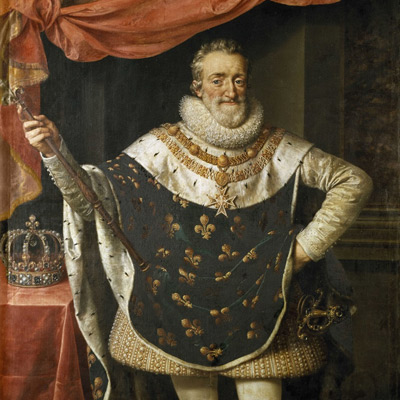
Here is a biography of Henry IV, the "Vert-Galant" (Green Gallant), structured in paragraphs to trace the life of the man who ended the Wars of Religion. A Protestant Prince in Turmoil Born in 1553 in Pau, Henry of Bourbon was the son of Jeanne d'Albret, Queen of Navarre, and Antoine de Bourbon. Raised in the Calvinist (Protestant) faith, he found himself thrust early into the heart of the bloody Wars of Religion that tore France apart. In 1572, his marriage to Marguerite de Valois (Queen Margot), sister of King Charles IX, was supposed to reconcile the two sides, but it led to the St. Bartholomew's Day Massacre. To survive, Henry was forced to convert to Catholicism and remained a captive at the French court for four years before escaping and taking command of the Protestant troops. The Conquest of the Throne and Religious Peace Upon the death of Henry III in 1589, Henry of Navarre became the rightful heir to the throne, but the Catholic League refused to recognize a Protestant king. For several years, he had to conquer his kingdom by force of arms. Realizing that a Protestant king could never rule over a predominantly Catholic France, he chose to abjure his faith once again in 1593, famously uttering the words, according to legend, "Paris is well worth a Mass." Crowned in Chartres, he entered the capital in triumph and, in 1598, signed the Edict of Nantes, a historic act of tolerance that granted freedom of worship to Protestants and finally brought peace. The Reconstruction of the Kingdom Once peace was restored, Henry IV set about rebuilding a country devastated by forty years of war. Supported by his minister Sully, he restored the finances, encouraged agriculture ("chicken in the pot"), and developed manufacturing. He was a builder king who modernized Paris with the construction of the Pont Neuf and the Place Royale (present-day Place des Vosges). He also supported the first expeditions to Canada, laying the foundations of the French colonial empire. Under his reign, royal authority was restored, paving the way for future absolutism, while maintaining an image of closeness to his people. A tragic end and the birth of a myth Despite his efforts to ease tensions, Henry IV remained the target of numerous plots, both from ultra-Catholics and disillusioned Protestants. On May 14, 1610, while traveling to the Arsenal in his carriage, he was stabbed to death by François Ravaillac, a fanatical Catholic. His brutal death provoked widespread emotion and instantly transformed the controversial sovereign into a national martyr. He remains in the collective memory as "Good King Henry", the peacemaker of France and one of the most beloved monarchs in history, a symbol of power that was both firm and humane.