
Key Dates
JEANNE D'ARC
"La pucelle"
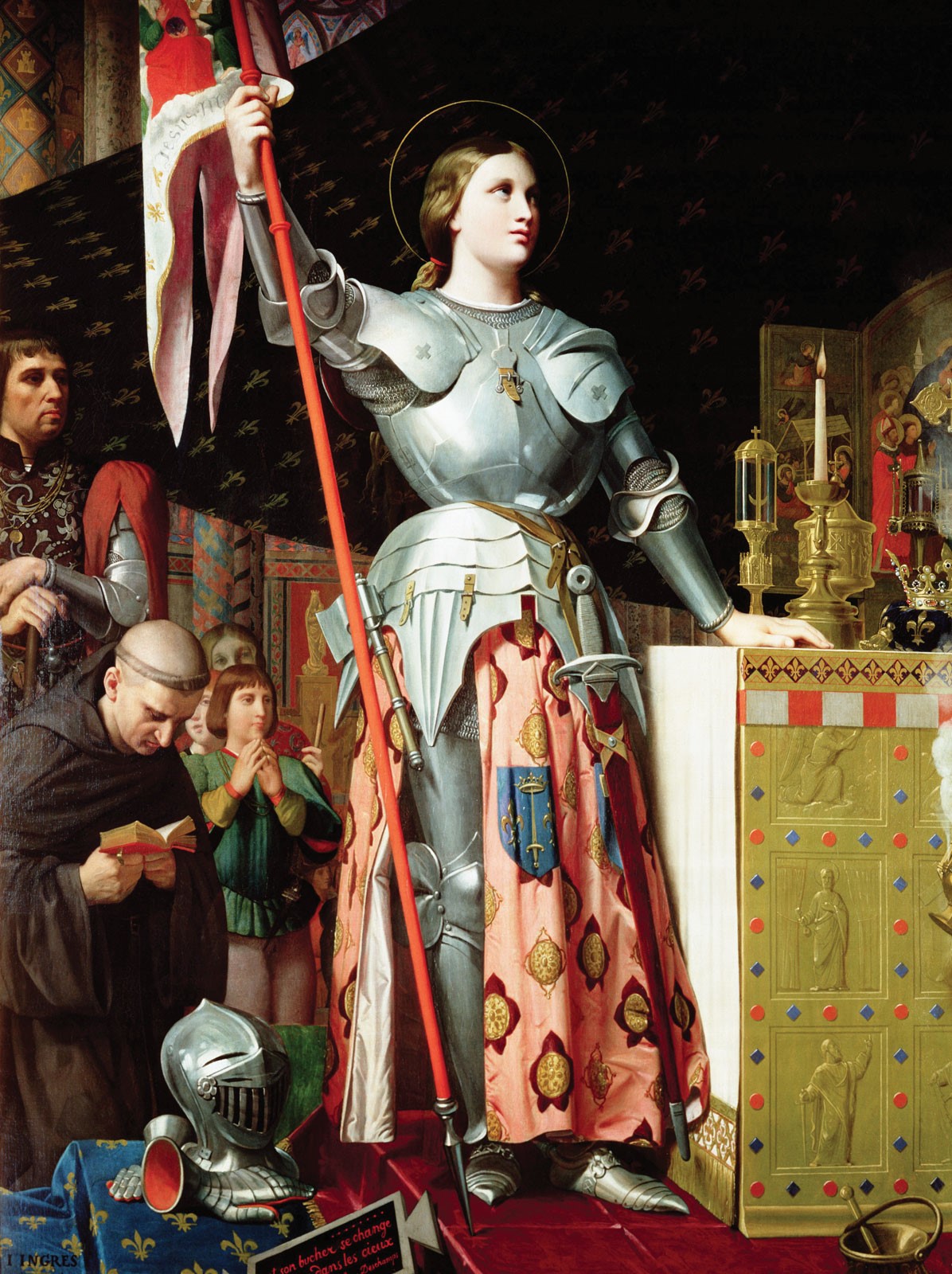
Born around 1412 in Domrémy, Lorraine, Joan grew up in a France torn apart by war between the Armagnacs (supporters of the Dauphin Charles VII) and the Burgundians, allies of the English. At the age of 13, she claimed to hear the "voices" of Saints Catherine and Margaret and the Archangel Michael. According to her, these voices commanded her to drive the English out of France and have the Dauphin crowned in Reims. Despite her young age and peasant status, her determination was such that she eventually obtained an escort to meet Charles VII in Chinon in 1429. The Military Epic and the Liberation of Orléans After convincing the king of her sincerity, Joan received armor and command of a small troop. In May 1429, she accomplished the impossible: she lifted the siege of Orléans in just a few days, restoring hope to a dying French camp. This miraculous victory was followed by other successes that paved the way to Reims. On July 17, 1429, she attended the coronation of Charles VII, thus fulfilling the main part of her mission. She then became a symbol of national unity and resistance against the occupiers. Capture and Trial as an Example Her luck turned in 1430 when she was captured by the Burgundians during the siege of Compiègne. Sold to the English, she was taken to Rouen to be tried by an ecclesiastical court presided over by Bishop Pierre Cauchon. The trial was primarily political: the aim was to prove that Charles VII owed his throne to a witch in order to discredit his legitimacy. Despite the subtlety of her responses to the theologians' traps, she was condemned for heresy and relapsed, notably because she persisted in wearing men's clothing. The Stake and the Birth of a Myth On May 30, 1431, at the age of 19, Joan of Arc was burned alive in the Place du Vieux-Marché in Rouen. Her ashes were thrown into the Seine to prevent any veneration of relics. However, her sacrifice was not in vain: it awakened French national sentiment. She was rehabilitated by a second trial in 1456, then canonized by the Catholic Church in 1920. Having become a global icon, she embodies today both the saint and the patriotic heroine, inspiring countless works of art and literature throughout the centuries.