
Key Dates
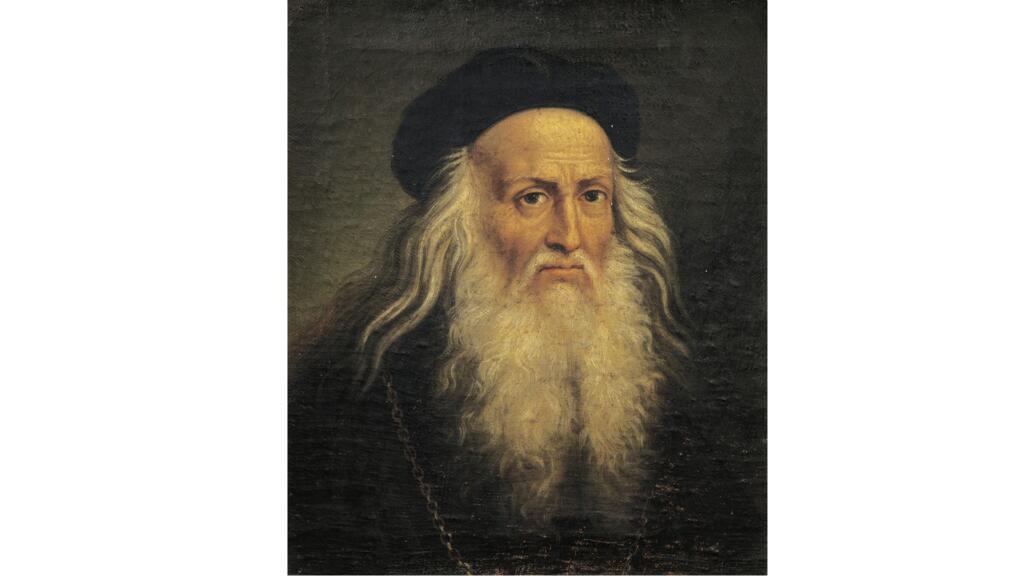
LEONARD DE VINCI
"Leonardo di ser Piero da Vinci"
Born in 1452 in Vinci, Tuscany, Leonardo was the illegitimate son of a notary and a peasant woman. Unable to follow in his father's footsteps, he was apprenticed in Florence to Andrea del Verrocchio, one of the greatest masters of the time. Very quickly, the student surpassed the master: his precision, his sense of light, and his ability to bring life to the canvas were impressive. In Florence, he began to develop his sfumato technique, this "vaporous" effect that allowed him to blend outlines and give his portraits an unprecedented psychological depth, breaking with the rigidity of the Middle Ages. The engineer and observer of nature Leonardo did not consider himself merely a painter, but a scientist. In 1482, he settled in Milan in the service of Duke Ludovico Sforza, to whom he presented himself primarily as a military engineer capable of designing revolutionary war machines. Passionate about anatomy, botany, and hydraulics, he filled thousands of pages of notebooks (the Codices) with drawings and observations. He dissected cadavers to understand the mechanics of muscles, studied the flight of birds to imagine flying machines, and drew up ideal urban plans, convinced that art must be based on a rigorous scientific understanding of the world. Masterpieces and the Quest for Perfection Leonardo's career is marked by several iconic works that have changed the history of art. In Milan, he painted The Last Supper, a revolutionary fresco in its handling of perspective and human emotion. Later, he began the portrait of Lisa Gherardini, the famous Mona Lisa, which he would continually rework for years, carrying the painting everywhere with him. His perfectionism was such that he left many works unfinished, preferring the exploration of an idea or a technique to the physical completion of his commissions, which sometimes earned him the impatience of his patrons. Gilded Exile at Clos Lucé The end of his life was marked by a privileged relationship with King Francis I of France. In 1516, at the invitation of the sovereign, who deeply admired him, Leonardo crossed the Alps to settle at the Château du Clos Lucé, near Amboise. Appointed "First Painter, Engineer, and Architect to the King," he organized sumptuous festivities, worked on canal projects, and drew up plans for an ideal château in Romorantin. He died in 1519, surrounded by his manuscripts and paintings, leaving behind an immense intellectual legacy that continues, five centuries later, to fascinate the world with its modernity.