
Stone Sentinels: Military Engineering at the Heart of the Territories
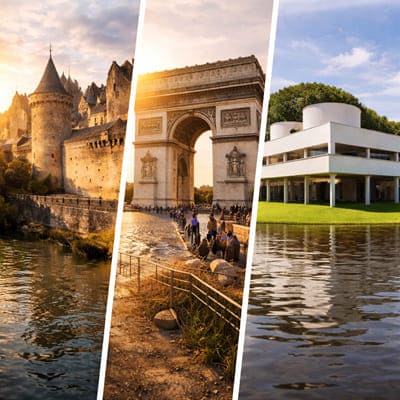
France's military heritage traces a geography of power, a network of steel and stone that protected the kingdom's borders for nearly a millennium. From the vertiginous cliffs of the Citadel of Bonifacio to the Alpine peaks of Mont-Dauphin, these structures bear witness to the radical evolution of defense techniques. Whether medieval fortresses with their imposing towers, such as those at Angers, Coucy, or Carcassonne, or bastioned structures designed to withstand modern artillery, like the Fortress of Salses, these sites are feats of engineering. Exploring the Towers of La Rochelle, the ramparts of Aigues-Mortes, or Fort Saint-André is to delve into an architecture of deterrence where every loophole, every ditch, and every machicolation played a vital role in the nation's survival.
Stone Sentinels: The Greatest Fortifications of France arrow_forwardPierre's Memory: The Great Commemorative Monuments of France
From Roman antiquity to the scars of the 20th century, the French landscape is punctuated by monumental buildings designed to defy oblivion and celebrate grandeur. The Trophy of Augustus at La Turbie remains one of the oldest testaments to the power of Rome, while the Arc de Triomphe in Paris and the Column of the Grande Armée at Wimille enshrine the Napoleonic epic in stone. This desire to sacralize history is also found in the Panthéon, a temple dedicated to "Great Men," but also in the Gothic splendor of the Royal Monastery of Brou, a dynastic mausoleum erected out of love. Finally, the Caen Memorial carries this mission into the contemporary era, offering a necessary reflection on global conflicts. Exploring these sites means traversing the milestones of a collective memory where architecture becomes the eternal narrative of triumphs and sacrifices.
Pierre's Memory: The Great Commemorative Monuments of France arrow_forwardIcons of Modern Architecture: A Journey Between Simplicity and Light
Modern architecture isn't something you simply visit; it's something you experience. In the 20th century, a radical break occurred: concrete, glass, and steel replaced cut stone to fulfill an ideal of clarity and functionality. Le Corbusier's Villa Savoye (78), a veritable "machine for living" raised on stilts, and Mallet-Stevens' Villa Cavrois (59), a modern château with perfect geometric lines, exemplify this aesthetic revolution. On the French Riviera, the Cap Moderne site offers a fascinating dialogue between the sensitive architecture of Eileen Gray's Villa E-1027 and the asceticism of Le Corbusier's Cabanon. Here, space is liberated, the roof becomes a garden, and light becomes a building material in its own right, defining the standards of our contemporary comfort.
Icons of Modern Architecture: A Journey Between Simplicity and Light arrow_forward