
The Climate Challenge: Loire Valley Castles Facing the 2026 Floods
The beginning of 2026 placed the jewels of the Loire Valley in a critical situation. Record rainfall caused the Cher, Indre, and Cosson rivers to burst their banks, transforming iconic monuments into isolated islands of stone.
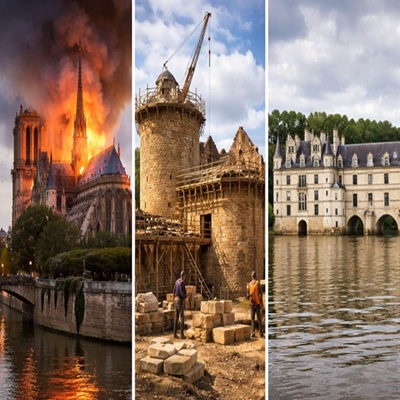
While the image of Chenonceau floating on a raging Cher or Azay-le-Rideau encircled by water is strikingly romantic, it masks a major technical challenge: the stability of the foundations. These buildings often rest on centuries-old oak piles which, to remain solid, must stay submerged. The paradoxical danger lies in the receding floodwaters: too rapid a drop in water level or the drying out of the soil can weaken these structures. At Chambord, it is the porosity of the tufa stone that is a cause for concern, as the stone literally absorbs the moisture from the rising water table. This episode serves as a reminder that climate change necessitates constant health monitoring of our most famous monuments.
Heritage on the Edge: Scars and Disappearances
French history is punctuated by tragedies where heritage sites nearly perished. Some did not survive, like the Tuileries Palace, a jewel of the Louvre, which burned down in 1871 and was razed by political decision, leaving a gaping void in the heart of Paris. Others still bear the marks of their fragility.
These destructions, whether due to war, fire, or financial neglect (as with Amboise, which lost 80% of its surface area in the 19th century), underscore that the preservation of a monument is a daily battle against oblivion.
The Art of the Renaissance: When Passion Reconstructs the Past
Fortunately, destruction is not always the end. France excels in the art of reconstruction, balancing scientific rigor with a romantic vision.
The Guédelon construction site is undoubtedly the purest example: here, a 13th-century castle is being built using medieval tools to understand the secrets of the ancients. At Pierrefonds, it was the genius of Viollet-le-Duc that resurrected a ruin, transforming it into an ideal castle that has become the archetype of a fairy tale. More recently, the Château de Lunéville, after its 2003 fire, proved that French craftsmanship (stonemasons, carpenters) can achieve miracles of precision.
Finally, more atypical projects like that of La Mothe-Chandeniers are opening a new path: collective ownership. This castle "inhabited by the forest" is now saved by thousands of citizens from all over the world, proving that while stone is fragile, the human will to preserve beauty is indestructible.