
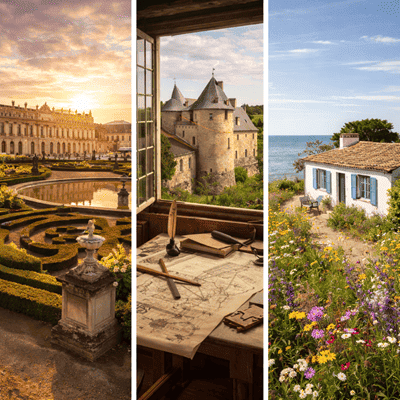
The Dwellings of Power: From the Royal Splendor of Louis XIV to the Intimacy of Great Men
Built heritage reflects French political ambition. At the pinnacle of this hierarchy stands the Palace of Versailles, the work of Louis XIV, where architecture serves as a stage for absolute power. But French power was also built on its borders thanks to the genius of Vauban. His Château de Bazoches, in the Morvan region, reveals the other side of the coin: it was here that he conceived his "iron belt" protecting the kingdom. On the Isle of Beauty (Corsica), the Maison Bonaparte in Ajaccio reminds us of the Emperor's Corsican roots, while in the Vendée region, the Maison de Georges Clemenceau offers a striking contrast: a fisherman's cottage facing the Atlantic, the ultimate refuge of "The Father of Victory." These sites illustrate how the destiny of France was forged by men whose homes reflected either glory or the rigor of service to the State.
The Dwellings of Power: From the Royal Splendor of Louis XIV to the Intimacy of Great Men arrow_forwardArtists' Homes: When Living Space Becomes the Ultimate Artwork
For great artists, living spaces are often a direct extension of their palette or their chisel. In Giverny, Claude Monet's house and gardens have become the very work of the master of Impressionism, each flower conceived to be painted. In Touraine, the Château du Clos Lucé preserves the universal spirit of Leonardo da Vinci, who lived there during his final years under the patronage of Francis I. Sculpture, meanwhile, finds its true expression at the Rodin Museum in Paris, where the elegance of the Hôtel Biron enhances Auguste's bronzes, and at the Camille Claudel Museum in Nogent-sur-Seine. The latter, located where the artist took her first steps, finally does justice to her tragic genius in a setting of contemporary light.
Artists' Homes: When Living Space Becomes the Ultimate Artwork arrow_forwardWriters' Houses: Literary Sanctuaries and Centers of French Thought
French literature has its sanctuaries, places where words still seem to resonate in the air. In Paris, Victor Hugo's house on the Place des Vosges immerses us in the romantic world of a writer who was also a brilliant decorator. In Ferney, Voltaire's Château bears witness to the Enlightenment's fight against obscurantism, while George Sand's house in Nohant opens the doors to a salon frequented by the entire artistic elite of the 19th century. Further west, Ernest Renan's childhood home in Tréguier illustrates Breton intellectual austerity. Finally, in Médan, Émile Zola's house and the Dreyfus Museum seal the alliance between naturalism and the civic engagement of "J'accuse…!" These residences are not simply museums, but the roots of a French thought that remains ever-present.
Writers' Houses: Literary Sanctuaries and Centers of French Thought arrow_forward