
Cathedrals: Bibles of Stone and Glass
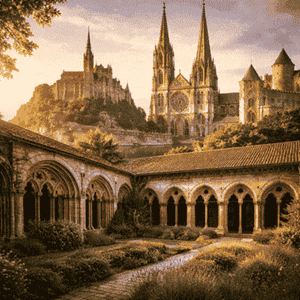
French cathedrals represent the pinnacle of medieval engineering and the purest expression of faith transformed into monumental architecture. Throughout the country, these stone vessels, such as Notre-Dame de Reims, the sacred site of the coronation of kings, or Chartres Cathedral, famous for its stained-glass windows of unparalleled blue, bear witness to an era that sought to capture divine light. The evolution of the Gothic style unfolds with fascinating audacity, from the robust pillars of Autun to the airy delicacy of the nave of Amiens, the largest in France. These edifices are not merely places of worship, but veritable open-air Bibles where sculpted portals and astronomical clocks, like the one in Besançon, tell the story of the world and the stars. Upon entering these premises, the visitor is immediately struck by the verticality of the vaults and the polychromy of the stained glass windows which transform the space into a theatre of light changing according to the hours of the day.
The Cathedrals of France: Masterpieces in Stone and Mirrors of History arrow_forwardAbbeys and Monasteries: The Art of Silence
Exploring the abbeys of France leads the traveler toward an aesthetic of simplicity and a quest for absolute serenity far from the hustle and bustle of city life. From iconic sites like Mont-Saint-Michel Abbey, a marvel built on a rocky islet between sky and sea, to the Cistercian rigor of Thoronet or Fontenay, these monasteries illustrate the perfect harmony between humankind, stone, and nature. At Cluny, one can still sense the power of what was once the beacon of Western Christendom, while at Fontevraud, the royal effigies rest beneath vaults of sovereign elegance. Monastic life has bequeathed a legacy of botanical gardens, light-filled cloisters, and scriptoria where knowledge was preserved for centuries. Visiting an abbey like Sénanque, framed by its lavender fields, or Moissac with its magnificent tympanum, is to immerse oneself in an atmosphere of contemplation where each semicircular arch and each hewn stone seems to have been placed to promote meditation and inner peace.
Abbeys and Monasteries: The Art of Silence arrow_forwardThe Cloisters: Oasis of Serenity and Sculpture
The cloister forms the beating, secret heart of large ecclesiastical complexes, offering a transitional space between the earthly world and the spiritual life of the canons or monks. These covered galleries, often adorned with twin columns and finely carved capitals, surround gardens that symbolize paradise lost. In Bayonne, the Gothic cloister impresses with its size and light, while that of the Psalette in Tours reveals a delicate transition to the Renaissance with its single spiral staircase. The cloister of Fréjus is distinguished by its incredible painted larchwood ceiling, where hundreds of medieval figures observe the visitor, offering a precious glimpse into the popular imagination of the Middle Ages. These spaces, often more intimate than the churches they adjoin, allow one to appreciate the virtuosity of the sculptors who immortalized in stone fantastical bestiaries, scenes of daily life, and plant motifs of breathtaking botanical precision.
The Cloisters: Oasis of Serenity and Sculpture arrow_forwardUNESCO World Heritage: Architectural Excellence
UNESCO recognition underscores the outstanding universal value of numerous French monuments that mark the paths of history, from Roman antiquity to the industrial age. The Cité de Carcassonne transports visitors into a medieval epic with its double ramparts and defensive towers, while the Pont du Gard remains the most spectacular testament to Roman civil engineering in Gaul. This prestigious listing encompasses sites as diverse as the Royal Saltworks of Arc-et-Senans, the utopian vision of the architect Ledoux, and the Palais du Tau in Reims, guardian of the coronation treasury. From the Pey-Berland Tower in Bordeaux, which offers a breathtaking panorama of the stone city, to the Maison Carrée in Nîmes, an ancient temple of miraculous preservation, these sites constitute the elite of world heritage. They demand exemplary management and offer tourists the guarantee of a first-rate cultural experience, where rigorous conservation makes it possible to transmit to future generations the splendor of these major witnesses of human civilization.
UNESCO World Heritage Sites: The Must-See Treasures of France arrow_forward